
Nye Bevans legacy came into the world 78 years ago this morning when, then Minister of Health in Attlee’s post-war government, Nye Bevan, the Labour Minister of Health, symbolically marked the occasion at Park Hospital in Davyhulme, near Manchester (now Trafford General Hospital). He received the keys from Lancashire County Council, and the hospital is widely recognised as the “birthplace of the NHS.”
Nye was one of the most important ministers of the post-war Labour Government and the chief architect of the NHS. He was born on 15 November 1897 in Tredegar in Wales. His father was a miner from a poor working class family in which Bevan gained first hand experiences of the problems of poverty and disease.
He was a rebel with many causes but is remembered mostly as the architect of the National Health Service. He remembered how he had witnessed families with dreaded sickness who could not afford to pay doctors bills. In his home town of Tredegar there existed a working mens medical aid society which was to serve him inspiration. He envigaged an NHS with comprehensive provision was on patient need, not wealth.
Never one to back off from a fight , he bullied and cajoled , reasoned and argued until Health care free at the point of delivery was to become a right instead of a luxury, and helped make the biggest improvements to the quality of life for the average British person in living memory.
Bevan on this day met 13-year-old Sylvia Diggory, often described as the first NHS patient. This was the climax of years of planning to deliver comprehensive healthcare free at the point of use, funded mainly through taxation (and National Insurance contributions), available to all regardless of ability to pay.
At the outbreak of the Second World War, the Ministry of Health established central coordination over voluntary (charity-run) and municipal hospitals. This gave government direction over hospital resources for wartime casualties and demonstrated that a nationally coordinated system was feasible. It directly influenced post-war thinking.
In 1942 The Beveridge Report: Economist William Beveridge’s Social Insurance and Allied Services identified the “five giants” on the road to reconstruction: Want (poverty), Disease, Ignorance, Squalor, and Idleness (unemployment). It proposed a comprehensive welfare state with universal social insurance and a national health service free at the point of use. The report was hugely popular with the public and shaped the post-war Labour government’s agenda (though the detailed structure of the NHS was developed later).
In 1944 The Wartime Coalition White Paper: Under Conservative Health Minister Henry Willink, the coalition government published A National Health Service. It proposed a comprehensive, free service but placed administration with local authorities (joint boards) and left most voluntary hospitals independent.
In 1945–1946 Bevan’s radical plan: After Labour’s landslide victory, Bevan rejected local-authority control as too fragmented. His plan nationalised all hospitals (voluntary and municipal) and created a regional structure under central government.
After tough Cabinet and parliamentary negotiations (with some concessions), the National Health Service Act 1946 received Royal Assent on 6th November 1946 and came into force on 5th July 1948. The British Medical Association (BMA) strongly opposed key elements, fearing loss of professional independence, a salaried service, and reduced earnings. In January 1948 a BMA vote showed 84% of GPs against joining. There were threats of non-cooperation or boycott. Bevan negotiated hard, securing the participation of the vast majority of doctors by launch day through concessions: GPs remained independent contractors paid by capitation (per patient registered); consultants could continue private practice. Bevan later quipped that he had to “stuff their mouths with gold” to win over the consultants. The public overwhelmingly welcomed the NHS. Around 95% of the population had registered with a GP before launch. In a society still recovering from war, facing austerity, and accustomed to state planning, the promise of care “from the cradle to the grave” without the fear of crippling medical bills resonated deeply. Post-war anxieties about infectious diseases (measles had no vaccine until the 1960s and could cause serious complications) formed part of the broader health context, though the primary appeal was universal access and security.
The NHS represented a bold post-war vision realised through compromise. It transformed healthcare access for millions and remains one of Britain’s most enduring institutions.
Nye Bevan, once wrote, “No society can legitimately call itself civilised if a sick person is denied medical aid because of lack of means.” This statement, which is at the heart of our health service, still commands support from the vast majority of the UK population. The NHS encapsulates everything which Bevan stood for, and was the culmination of a life devoted to improving the lives of men and women across the country.

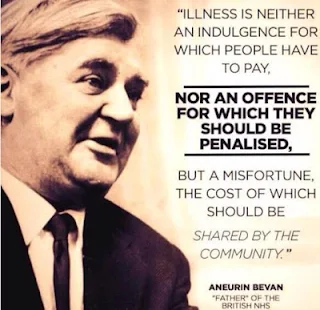
For the first-time doctors, nurses, opticians, dentists and pharmacists all worked under one organisation. It was a ray of hope in that bleak time, and it remains one today. The creation of the NHS in 1948 was the product of years of hard work and a motivation from various figures who felt the current healthcare system was insufficient and needed to be revolutionised.
Born to a post-war Britain amidst the rubble of war and a skeptical medical profession, the NHS has had its ups and downs over the years. However, its role and importance as a symbol of our Britishness and intense pride in being able to provide universal care, free at the point of delivery, has remained throughout, out of the belief that healthcare should be available to all, regardless of wealth, with health and care as priorities – not profit, .these ideals remains one of the NHS’s core principles.

Aneurin Bevan, Minister of Health, on the first day of the National Health Service, 5 July 1948 at Park Hospital, Davyhulme, near Manchester.
These ideas can be traced back to the early 1900s with the Minority Report of the Royal Commission on the Poor Law in 1909. The report was headed by the socialist Beatrice Webb who argued that a new system was needed to replace the antiquated ideas of the Poor Law which was still in existence from the times of the workhouses in the Victorian era. Those who were involved in the report believed it was a narrow-minded approach from those in charge to expect those in poverty to be entirely accountable for themselves. Despite the strong arguments provided in the report, it still proved unsuccessful and many ideas were disregarded by the new Liberal government.
Nevertheless, more and more people were beginning to speak out and be proactive, including Dr Benjamin Moore, a Liverpool physician who had great foresight and a pioneering vision of the future in healthcare. His ideas were written in “The Dawn of the Health Age” and he was probably one of the first to use the phrase ‘National Health Service’. His ideas led him to create the State Medical Service Association which held its first meeting in 1912. It would be another thirty years before his ideas would feature in the Beveridge Plan for the NHS.
Few now remember life before the NHS. Until 4 July 1948, every visit to a GP or hospital had to be paid for, unless covered by insurance or charity. Workers paid National Insurance but their dependents weren’t covered. Many families couldn’t afford private insurance, weren’t poor enough for ‘charity’, so suffered without health care. In some cases local authorities ran hospitals for the local ratepayers, an approach originating with the Poor Law. By 1929 the Local Government Act amounted to local authorities running services which provided medical treatment for everyone. On 1st April 1930 the London County Council then took over responsibility for around 140 hospitals, medical schools and other institutions after the abolition of the Metropolitan Asylums Board.
The idea of a state-run health service was mooted at the Labour Party Conference in 1934 by the then president of the Socialist Medical Association, Dr Somerville Hastings. Then the Beveridge Report of December 1942 called for 'Comprehensive Health and Rehabilitation Services' and set the seeds for the creation of the NHS and the creation of the Welfare State. Winston Churchill's attitude was one of ambivalence and when two years after the Beveridge report and it had become Labour Party policy, he became markedly more hostile. It was then Aneurin Bevan who wholeheartedly embraced and made sure the project was implemented and delivered after he became health minister in 1945.
It was a ray of hope in that bleak time, and it remains one today. The free service, based on need, not what money you have, is something that has become cherished by generation after generation. Many see it as Labour’s greatest socialist achievement.
Today, we have a lot to thank the NHS for; from the introduction of polio and diphtheria vaccinations to all under 15-year olds to the success of smoking cessation services and cancer screening services, the NHS has been instrumental in many of the medical achievements the UK has seen over the last 78 years. a shining example of what separates us from the US.
It offered for the first time a free healthcare system in the world that offered for completely free , healthcare that was made available on the basis of citizenship rather than the payment of fees or insurance. It has since played a vital role in caring for all aspects of our nations health. It has been the envy of the world ever since.
Today, nine in 10 people agree that healthcare should be free of charge, more than four in five agree that care should be available to everyone. The NHS remains one of our most precious national assets and is the institution that the public have said makes them most proud to be British. It is built on the effort, skill, and commitment of its staff, the support of patients and service users, and strong relationships with the communities it serves.
The deep love we have for our health service is one of the most tremendous aspects of living in Britain. The knowledge that if you ever get ill or have an accident, you’ll get the care you need, whatever your circumstances, is one of Labour’s greatest achievements.
It wouldn’t be possible to run a 7-day NHS, caring for millions of people day-in-day-out without the hard work and dedication of its staff. Despite all the adversity that’s thrown at them: poor pay, bursary cuts, hospital parking fines and staff shortages to name a few; they continue to become stronger and relentlessly deliver fantastic healthcare to the nation .The recent pandemic have once again highlighted the strength, professionalism , dedication and bravery of our healthcare staff. It is truly inspiring to see how amazing the staff handled the awful situation and it was a testament to every healthcare worker throughout the UK. They are a credit to our nation and we couldn’t be more proud.
The NHS here in Wales employs close to 72,000 staff which makes it Wales’ biggest employer.The NHS in Wales carries out around 360 thousand patient consultations every month in secondary care alone (not including GP visits or diagnostics) There are 79 babies born a day in Wales / with one birth every 18 minutes On average there are over 8,500 occupied NHS beds in Wales every day In the last 12 months, more than 20,000 patients started cancer treatment in Wales, But dedicated, compassionate staff are under increased pressure, leading to low moral. Recent figures have emerged that 2/4s of hospitals have been warned about dangerous staff shortages.
We should not forget Nye Bevan's words who said ' It will last as long as their are folk with enough faith to fight for it. Despite all its current issues and flaws it is still the UK's greatest achievement- free healthcare for all at point of need from cradle to grave. Nye Bevan's words ring as true today as they ever did.
On its birthday we should remember the NHS is a shining example of how a caring society can create good and safe care based on social solidarity., making such a great contribution towards social and health equality. A shining beacon to the world.
But while its values have stayed the same, almost everything else has changed. Back in 1948, hospitals looked very different. There were no MRI scanners, no video appointments and definitely no NHS App. Doctors relied on far fewer tests and treatments than they do today, and many illnesses that are now treatable were much more dangerous.
Since then, medicine and the NHS has come a long way. Today, surgeons can perform incredibly complex operations, cancer treatments are more effective than ever, and babies born much earlier than expected have a much better chance of surviving thanks to advances in neonatal care. Technology has also made healthcare faster in many ways, with digital patient records, online prescriptions and virtual GP appointments becoming part of everyday life.
Of course, none of this would be possible without the people working behind the scenes. When people think of the NHS, they often picture doctors and nurses, but there are thousands of other staff who keep it running. Paramedics, receptionists, cleaners, porters, pharmacists, therapists and laboratory scientists all play an important role in caring for patients.
The COVID-19 pandemic reminded the country just how important the NHS really is. Staff worked incredibly long hours under huge pressure, treating patients while also delivering one of the biggest vaccination programmes the UK has ever seen. It was a difficult time, but it showed the dedication of NHS workers across the country.
However, the NHS faces some big challenges today. Waiting lists are still high in many areas, emergency departments are often under pressure, and an ageing population means more people need healthcare than ever before. Recruiting and keeping enough staff is another challenge, as demand continues to grow.
Currently in real danger, under attack from those that want to privatise it, run it down and fragment it ;
despite this, the NHS continues to adapt. Artificial intelligence is beginning to help doctors spot illnesses earlier, new medicines are being developed all the time and researchers are constantly finding better ways to treat patients.
After 78 years, the NHS has seen enormous changes, but its original aim has never changed, to provide healthcare based on need, not on a person’s ability to pay and by fixing social care, improving access, and protecting its future, we can ensure our health service thrives.
The best way we can mark the 78th anniversary is to vow to remain true to the principles that underpinned the NHS from the beginning – treatment free from private companies and free at the point delivery. Now more than ever we need to fight for an NHS fit to work in and fit for purpose for another 78 years or more. and we must protect it from privatisation at all costs.
The NHS has sadly been systematically dismantled by both Conservative and Labour governments over four decades, with private US healthcare companies poised to feast on the carcass. The NHS was not given to us by the rich or powerful. It was won by struggle, built on the principle that healthcare is a right, not a privilege. Every cut, every privatisation, is a betrayal. The fight now is to save what we have already paid for.
The NHS holds a very special place in my heart, as I know it does for millions of people across our country. At some point in our lives, we have all needed its care, whether for ourselves, our children, our parents, or someone we love.
The greatest gift of the NHS is knowing that, in our moments of illness, fear and vulnerability, we can receive care and treatment regardless of our income or background.
Today, I celebrate this great institution and, most importantly, the incredible people behind it, the doctors, nurses, paramedics, carers, cleaners, porters, receptionists and many others who work tirelessly to care for us.
This great institution only exists because of the wonderful staff of all nationalities that provide care from the cradle to the grave with empathy and compassion and without judgement or prejudice.
As the Government inevitably puts out celebratory tweets today remember they are privatising it and with American plutocrats turning their eyes on the NHS, it's more important than ever that we continue to defend it with all we've got, Now, more than ever, it is vital that we stand together to defend our NHS from those who seek to underine its core values.
Thank you NHS from the bottom of my heart for being there for me, my family and our communities. I deeply appreciate you and when the Government inevitably put out celebratory tweets today I remember they are privatising it and with American plutocrats turning their eyes on the NHS. It's more important than ever that we continue to defend you with all we've got.
Now, more than ever, it is vital that we stand together to defend you from those who seek to undermine its core values. elebrate you. Your the best thing this country has ever created and you deserves so much better.
Let's ensure you are here to stay. Thank you to every staff member and volunteer who' with skill and dedication have shaped our NHS - past, present and future. Built by Labour. Underfunded by the Tories. Targeted for privatisation by Reform. No matter who sits in 10 Downing Street, we must continue fighting to ensure our NHS gets the lifesaving investment it needs, and is protected from big pharma, big tech and private healthcare companies.Ensure that the NHS is free at the point of use, because healthcare should not depend on your bank balance.

A statue of Aneurin Bevan stands on Queen's Street in Cardiff, honouring his role in creating the service.


