Showing posts sorted by relevance for query 16th January. Sort by date Show all posts

Saturday, 16 January 2021

Remembering Chartist leaders found guilty of high treason in Newport Rising of 1839


The People’s Charter had been launched in the spring of 1838 to demand universal male suffrage and other egalitarian electoral reforms. - See more at: http://www.internationalsocialist.org.uk/index.php/2013/11/on-this-day-4111839-the-newport-rising/#sthash.1XaXbYTG.dpuf
The political movement of Chartism developed following the 1832 Reform Act due to the widespread disappointment at the provisions in the act.  In June 1836 the London’s Workingmen’s Association was formed and in 1838, the members launched a People’s Charter and National Petition which called for radical changes to the way in which Britain was governed.  Supporters of the movement were from then on known as Chartists.  
At the time only 19 percent of the adult male population of Britain could vote. The Chartists wanted the vote for all men (though not for women) and a fairer electoral system. They also called for annual elections, the payment of MPs, and the introduction of a secret ballot.Working conditions in many coalfields and ironworks in South Wales were harsh, and there was often conflict between workers and employers. Much of the working class population were living in poverty, but without a voice in politics, and they did  not feel they could change their situation, Given these circumstances, it was no surprise that Chartism developed quickly. In the summer of 1838 a Working Men's Association was formed in Newport, Monmouthshire to publicise the People's Charter.  
Within six months, the radical leader John Frost https://teifidancer-teifidancer.blogspot.com/2017/05/john-frost-radical-chartist-leader.html  estimated that there were between 15,000 and 20,000 Chartists in the county of Monmouthshire. Chartism fought for democratic demands, but it was not solely a democratic movement, it was a revolutionary class struggle to change society. William Price, https://teifidancer-teifidancer.blogspot.co.uk/2011/11/william-price-441800-2311893.html a Pontypridd Chartist leader said: "Oppression, injustice and the grinding poverty which burdens our lives must be abolished for all time."  
 The People's Charter called for six reforms to make the political system more democratic, namely:
  1. A vote for every man twenty-one years of age, of sound mind, and not undergoing punishment for a crime.
  2. The secret ballot to protect the elector in the exercise of his vote.
  3. No property qualification for Members of Parliament in order to allow the constituencies to return the man of their choice.
  4. Payment of Members, enabling tradesmen, working men, or other persons of modest means to leave or interrupt their livelihood to attend to the interests of the nation.
  5. Equal constituencies, securing the same amount of representation for the same number of electors, instead of allowing less populous constituencies to have as much or more weight than larger ones.
  6. Annual Parliamentary elections, thus presenting the most effectual check to bribery and intimidation, since no purse could buy a constituency under a system of universal manhood suffrage in each twelve-month period.
 
Tensions rose after the government turned down the mass petition for the Charter, presented to the House of Commons with over 1.25 million signatures.Leaders like John Frost and Henry Vincent called for 'physical force' to obtain the Charter, and to add further fuel to the indignation felt in May 1839  eloquent public speaker  Henry Vincent,https://teifidancer-teifidancer.blogspot.com/2018/05/henry-vincent-1051818-2912-1878-radical.html well known locally for his speaking tour of South Wales a year earlier, on 2 August all of 20 miles away in Monmouth was arrested for making inflammatory speeches. When he was tried on the 2nd August at Monmouth Assizes he was found guilty and sentenced to twelve months imprisonment. Vincent was denied writing materials and only allowed to read books on religion.
Chartists in Wales were furious and the decision was followed by several outbreaks of violence. John Frost called for a massive protest meeting to show the strength of feeling against the imprisonment of Henry Vincent. Frost's plan was to march on Newport where the Chartists planned to demand the release of Vincent.
On 4 November 1839,  some seven or eight thousand men from nearby iron and coal-mining villages assembled and  roused with much anger  marched into Newport ,and attempted to take control of the town. They marched to  Westgate Hotel, where they had heard that after several more arrests, local authorities were temporarily holding several chartists, began chanting "surrender our prisoners". However the authorities in Newport  had heard rumours that the Chartists were armed and planned to seize Newport. Stories also began to circulate that if the Chartists were successful in Newport, it would encourage others all over Britain to follow their example, so were waiting for them. Troops protecting the hotel were then given the order to begin firing into the crowd, killing at least 22 people, and another fifty being wounded and resulted  in  the uprising being bought to an abrupt end. Among the injured was a Chartist named John Lovell, who was shot in the thigh and badly wounded. It would be the last large scale uprising in the history of  mainland Britain.


                                                   the attack on Westgate Hotel
 
Following the Newport defeat, South Wales was placed under martial law and hundreds of Chartists arrested or forced into hiding.Within days  many of the alleged the ringleaders including Frost were arrested and in December"True Bills" for High Treason were found against 14 men and more than 40 counts for sedition, conspiracy, riot and burglary.

The 14 men committed for Trial were:

John Frost, age 54, a draper, Newport

Zephaniah Williams, age 44, an inn keeper, of Blaina

William Jones, age 30, a watchmaker & beer house keeper, of Pontypool

Charles Waters, age 26, a ship's carpenter, of Newport (formerly Chepstow)

John Lovell, age 41, a gardener, of Newport

Jenkin Morgan, age 40, a milkman, of Pillgwenlly

Richard Benfield, age 20, a miner, of Sirhowy

John Rees, age 40, a miner, of Tredegar

James Aust, age 25, a gardener, of Malpas (formerly of Caerleon)

Solomon Britton, age 23, a collier, of Garndiffaith

George Turner, age 37, a collier, of Blackwood

Edmund Edmunds, age 34, a mine agent, of Pontllanfraith

and, to be tried in their absence:

John Rees, (Jack 'the Fifer'), a stonemason, of Tredegar

David Jones, (Dai 'the Tinker'), of Tredegar

- but the two were never captured

The Trials commenced on 31st December 1839 - and all fourteen men faced the Death Penalty. 

 South Wales Chartist Song, 1839, to rally support for John Frost and other imprisoned leaders of the Newport Rising 1839. 

Uphold these bold Comrades who suffer for you,
Who nobly stand foremost, demanding your due,
Away with the timid, 'tis treason to fear—
To surrender or falter when danger is near.
For now that our leaders disdain to betray
'Tis base to desert them, or succour delay.

A Hundred years, a thousand years we're marching on the road 
The going isn't easy yet, we've got a heavy load 
The way is blind with blood and sweat & death sings in our ears 
But time is marching on our side, we will defeat the years.

We men of bone, of sunken shank, our only treasure death 
Women who carry at the breast heirs to the hungry earth 
Speak with one voice we march we rest and march again upon the years 
Sons of our sons are listening to hear the Chartist cheers 
Sons of our sons are listening to hear the Chartist cheers.

 John Frost's trial was heard first and this ended on the 8th January. Zephaniah Williams, on the 13th January and William Jones, on the 14th January. All three were found "guilty, with mercy".[This meant that although they were sentenced to death, the final decision to allow mercy was with Her Majesty and her Government] 
John Lovell, Charles Waters, Jenkin Morgan, Richard Benfield and John Rees - on the advice of their counsels, Messrs, Stone & Skinner, were urged to plead guilty in the hopes that the Crown prosecutors could prevail upon the Judges to set the death penalty aside in their cases and on the 15th January 1840, they appeared together in court and pleaded guilty. The remaining four Chartists in Monmouth gaol - James Aust, Solomon Britton, George Turner, Edmund Edmunds - were brought before the bar and to everyone's amazement, the Attorney General withdrew all charges against them and they were freed with a verbal admonishment.
On the 16th January 1840, John Frost, Zephaniah Williams and William Jones were sentenced by the Lord Chief Justice Sir Nicholas Tindal:

"After the most anxious and careful investigation of your respective cases, before juries of great intelligence and almost unexampled patience, you stand at the bar of this court to receive the last sentence of the law for the commission of a crime which, beyond all others, is the most pernicious in example, and the most injurious in its consequences, to the peace and happiness of human society - the crime of High Treason against your Sovereign. You can have no just ground of complaint that your several cases have not met with the most full consideration, both from the jury and from the court. But as the jury have, in each of those cases, pronounced you guilty of the crime with which you have been charges, I should be wanting in justice to them if I did not openly declare, that the verdicts which they have found meet with the entire concurrence of my learned brethren and myself.

In the case of all ordinary breaches of the law, the mischief of the offence does, for the most part, terminate with the immediate injury sustained by the individual against whom it is levelled. The man who plunders the property, or lifts his hand against the life of his neighbour, does by his guilty act inflict, in that particular instance, and to that extent, a loss or injury on the sufferer or his surviving friends. But they who, by armed numbers, or by violence, or terror, endeavour to put down established institutions, and to introduce in their stead a new order of things, open wide the flood-gates of rapine and bloodshed, destroy all security of property and life, and do their utmost to involve a whole nation in anarchy and ruin.

It has been proved, in your case, that you combined together to lead from the hills, at the dead hour of night, into the town of Newport many thousands of men, armed, in many instances, with weapons of a dangerous description, in order that they might take possession of the town, and supersede the lawful authority of the Queen, as a preliminary step to a more general insurrection throughout the kingdom.

It is owing to the interposition of Providence alone that your wicked designs were frustrated. Your followers arrive by day-light, and after firing upon the civil power, and upon the Queen's troops, are, by the firmness of the magistrates, and the cool and determined bravery of a small body of soldiers, defeated and dispersed. What would have been the fate of the peaceful and unoffending inhabitants of that town, if success had attended your rebellious designs, it is impossible to say. The invasion of a foreign foe would, in all probability, have been less destructive to property and life.

It is for the crime of High Treason, committed under these circumstances, that you are now called upon yourselves to answer; and by the penalty which you are about to suffer, you hold out a warning to all your fellow-subjects, that the law of your country is strong enough to repress and to punish all attempts to alter the established order of things by insurrection and armed force; and that those who are found guilty of such treasonable attempts must expiate their crime by an ignominious death.

I therefore most earnestly exhort you to employ the little time that remains to you in preparing for the great change that awaits you, by sincere penitence and by fervent prayer. For although we do not fail to forward to the proper quarter that recommendation which the jury have intrusted to us, we cannot hold out to you any hope of mercy on this side of the grave.

And now, nothing more remains than the duty imposed upon the court - to all of us a most painful duty - to declare the last sentence of the law, which is that you, John Frost, and you, Zephaniah Williams, and you, William Jones, be taken hence to the place from whence you came, and be thence drawn on a hurdle to the place of execution, and that each of you be there hanged by the neck until you be dead, and that afterwards the head of each of you shall be severed from his body, and the body of each, divided into four quarters, shall be disposed of as Her Majesty shall think fit, and may Almighty God have mercy upon your souls."

These three chartist leaders were the last men in Britain sentenced to be "hanged, drawn and quartered.
 
                                         
                                          Zepaniah Williams, John Frost, William Jones
 
 John Frost, Zephaniah Williams, William Jones - were returned to Monmouth Gaol to await public execution.  The Government had decided that an example should be made of three members of the lower middle classes for having misled thousands of workmen into taking insurrectionary action against Queen and State.
The severity of the sentences shocked many people and thanks to the vigorous lobbying and protests  in support of the convicted Chartists, it led to to their sentences being commuted to transportation for life.
When they actually received a total pardon in 1856. Jones stayed in Australia as a watchmaker and Williams stayed in Tasmania, where he subsequently made his fortune discovering coal. However, John Frost, who had worked as a school teacher in Tasmania, returned to Britain, where he received a triumphant welcome in Newport.
The Newport rising was a turning point for the Chartist movement. In response to the conditions, Chartists in Sheffield, the East End of London and Bradford planned their own risings. Samuel Holberry led an aborted rising in Sheffield on January 12th 1840; police action thwarted a major disturbance in the East End of London on January 14th, and on January 26th a few hundred Bradford Chartists staged a failed rising in the hope of precipitating a domino effect across the country. After this Chartism turned to a process of internal renewal and more systematic organisation, but the transported and imprisoned Newport Chartists were regarded as heroes and martyrs amongst workers. 
'Physical force Chartism' was no longer popular however, and an uprising of the size seen in Newport for the time being has never happened again. However the movement gained strength and popularity throughout Britain and although it failed its purpose at the time, five of the Six Points of the original Charter which the Chartists had campaigned for have since been conceded, only the demand for Annual Parliaments not so far being accepted. 
A beautiful mural depicting four scenes from the Newport Rising, located in a pedestrian underpass in the city, was  shamefully destroyed in 2013 to make way for a shopping center.https://teifidancer-teifidancer.blogspot.co.uk/2013/10/destruction-of-chartist-mural.html Despite this nearly two centuries after the drafting of the People’s Charter, long may the Chartists struggle and its leaders be remembered who helped give voice to the discontent of the time in their struggle for democracy. 

Thursday, 4 November 2021

Remembering the Newport Chartist Rising of 1839


The People’s Charter had been launched in the spring of 1838 to demand universal male suffrage and other egalitarian electoral reforms. - See more at: http://www.internationalsocialist.org.uk/index.php/2013/11/on-this-day-4111839-the-newport-rising/#sthash.1XaXbYTG.dpuf
On  the 4th  of November 1839 the Newport rising took place. Thousands of armed workers marched on Newport Wales, as part of the struggle for the People's Charter. Marchers attempted to free imprisoned Chartists, but were shot by soldiers leading to a number of deaths. The Newport Rising was  the last large-scale armed rising in Wales, by Chartists whose demands include democracy and the right to vote with a secret ballot.
The political movement of Chartism developed following the 1832 Reform Act due to the widespread disappointment at the provisions in the act.  In June 1836 the London’s Workingmen’s Association was formed and in 1838, the members launched a People’s Charter and National Petition which called for radical changes to the way in which Britain was governed.  Supporters of the movement were from then on known as Chartists.  
At the time only 19 percent of the adult male population of Britain could vote. The Chartists wanted the vote for all men (though not for women) and a fairer electoral system. They also called for annual elections, the payment of MPs, and the introduction of a secret ballot.Working conditions in many coalfields and ironworks in South Wales were harsh, and there was often conflict between workers and employers. Much of the working class population were living in poverty, but without a voice in politics, and they did  not feel they could change their situation, Given these circumstances, it was no surprise that Chartism developed quickly. In the summer of 1838 a Working Men's Association was formed in Newport, Monmouthshire to publicise the People's Charter.  
Within six months, the radical leader John Frost https://teifidancer-teifidancer.blogspot.com/2017/05/john-frost-radical-chartist-leader.html  estimated that there were between 15,000 and 20,000 Chartists in the county of Monmouthshire. Chartism fought for democratic demands, but it was not solely a democratic movement, it was a revolutionary class struggle to change society. William Price, https://teifidancer-teifidancer.blogspot.co.uk/2011/11/william-price-441800-2311893.html a Pontypridd Chartist leader said: "Oppression, injustice and the grinding poverty which burdens our lives must be abolished for all time."  
 The People's Charter called for six reforms to make the political system more democratic, namely:
  1. A vote for every man twenty-one years of age, of sound mind, and not undergoing punishment for a crime.
  2. The secret ballot to protect the elector in the exercise of his vote.
  3. No property qualification for Members of Parliament in order to allow the constituencies to return the man of their choice.
  4. Payment of Members, enabling tradesmen, working men, or other persons of modest means to leave or interrupt their livelihood to attend to the interests of the nation.
  5. Equal constituencies, securing the same amount of representation for the same number of electors, instead of allowing less populous constituencies to have as much or more weight than larger ones.
  6. Annual Parliamentary elections, thus presenting the most effectual check to bribery and intimidation, since no purse could buy a constituency under a system of universal manhood suffrage in each twelve-month period.
 
There was much more to Chartism than the six points. This was a manifesto, an umbrella under which different campaigns and objectives could shelter. Many Chartists made improving the living standards of working people a priority: a more democratic and representative political system would be the means to achieve such an end. Some imagined a different economic system involving workers' control of industry. Others were attracted by utopian visions of communitarian societies. There were Chartist newspapers, Chartist churches, Chartist schools and Chartists who put as much energy into campaigning for temperance as for the People's Charter. It was a very wide-ranging and amorphous movement that embraced communities the length and breadth of Britain.  
Chartism though  was not solely a democratic movement, it was a revolutionary class struggle to change society. To Frederick Engels it was "the compact form of the proletariat's opposition to the bourgeoisie". William Price, : "Oppression, injustice and the grinding poverty which burdens our lives must be abolished for all time."
Tensions rose after the government turned down the mass petition for the Charter, presented to the House of Commons with over 1.25 million signatures.Leaders like John Frost and Henry Vincent called for 'physical force' to obtain the Charter, and to add further fuel to the indignation felt in May 1839  eloquent public speaker  Henry Vincent,https://teifidancer-teifidancer.blogspot.com/2018/05/henry-vincent-1051818-2912-1878-radical.html well known locally for his speaking tour of South Wales a year earlier, on 2 August all of 20 miles away in Monmouth was arrested for making inflammatory speeches. When he was tried on the 2nd August at Monmouth Assizes he was found guilty and sentenced to twelve months imprisonment. Vincent was denied writing materials and only allowed to read books on religion.
Chartists in Wales were furious and the decision was followed by several outbreaks of violence. John Frost called for a massive protest meeting to show the strength of feeling against the imprisonment of Henry Vincent. Frost's plan was to march on Newport where the Chartists planned to demand the release of Vincent.
7,500 armed workers with pikes, clubs and firearms eagerly began the long march from the heads of the Valleys to Newport on 3 November. They had been preparing long enough. They knew that some would not return but believed that those that did would be free. 
George Shell, a 15-year old Pontypool carpenter wrote to his parents: "I shall this night be engaged in a glorious struggle for freedom and should it please God to spare my life, I shall see you soon; but if not grieve not for me. I shall have fallen in a noble cause. Farewell!" George Shell was killed the next day.
On 4 November 1839,  these men  roused with much anger  marched into Newport ,and attempted to take control of the town. They marched to  Westgate Hotel, where they had heard that after several more arrests, local authorities were temporarily holding several chartists, began chanting "surrender our prisoners"
However the authorities in Newport  had heard rumours that the Chartists were armed and planned to seize Newport. Stories also began to circulate that if the Chartists were successful in Newport, it would encourage others all over Britain to follow their example, so were waiting for them. About 60 soldiers from the 45th Regiment and special constables, alerted by spies, barricaded the hotel. As marchers stormed the building, soldiers fired volleys from windows. In under 30 minutes, at least 22 Chartists were killed (some sources say 24+), over 50 wounded, and 4 soldiers injured. No prisoners were actually held there, it was a rumour or trap.  


                                                   the attack on Westgate Hotel
 
Following the Newport defeat, South Wales was placed under martial law and hundreds of Chartists arrested or forced into hiding. Within days  many of the alleged the ringleaders including Frost were arrested and in December "True Bills" for High Treason were found against 14 men and more than 40 counts for sedition, conspiracy, riot and burglary.

The 14 men committed for Trial were:

John Frost, age 54, a draper, Newport

Zephaniah Williams, age 44, an inn keeper, of Blaina

William Jones, age 30, a watchmaker & beer house keeper, of Pontypool

Charles Waters, age 26, a ship's carpenter, of Newport (formerly Chepstow)

John Lovell, age 41, a gardener, of Newport

Jenkin Morgan, age 40, a milkman, of Pillgwenlly

Richard Benfield, age 20, a miner, of Sirhowy

John Rees, age 40, a miner, of Tredegar

James Aust, age 25, a gardener, of Malpas (formerly of Caerleon)

Solomon Britton, age 23, a collier, of Garndiffaith

George Turner, age 37, a collier, of Blackwood

Edmund Edmunds, age 34, a mine agent, of Pontllanfraith

and, to be tried in their absence:

John Rees, (Jack 'the Fifer'), a stonemason, of Tredegar

David Jones, (Dai 'the Tinker'), of Tredegar

- but the two were never captured

The Trials commenced on 31st December 1839 - and all fourteen men faced the Death Penalty. 

 South Wales Chartist Song, 1839, to rally support for John Frost and other imprisoned leaders of the Newport Rising 1839. 

Uphold these bold Comrades who suffer for you,
Who nobly stand foremost, demanding your due,
Away with the timid, 'tis treason to fear—
To surrender or falter when danger is near.
For now that our leaders disdain to betray
'Tis base to desert them, or succour delay.

A Hundred years, a thousand years we're marching on the road 
The going isn't easy yet, we've got a heavy load 
The way is blind with blood and sweat & death sings in our ears 
But time is marching on our side, we will defeat the years.

We men of bone, of sunken shank, our only treasure death 
Women who carry at the breast heirs to the hungry earth 
Speak with one voice we march we rest and march again upon the years 
Sons of our sons are listening to hear the Chartist cheers 
Sons of our sons are listening to hear the Chartist cheers.

John Frost's trial was heard first and this ended on the 8th January. Zephaniah Williams, on the 13th January and William Jones, on the 14th January. All three were found "guilty, with mercy".[This meant that although they were sentenced to death, the final decision to allow mercy was with Her Majesty and her Government] 
John Lovell, Charles Waters, Jenkin Morgan, Richard Benfield and John Rees - on the advice of their counsels, Messrs, Stone & Skinner, were urged to plead guilty in the hopes that the Crown prosecutors could prevail upon the Judges to set the death penalty aside in their cases and on the 15th January 1840, they appeared together in court and pleaded guilty. The remaining four Chartists in Monmouth gaol - James Aust, Solomon Britton, George Turner, Edmund Edmunds - were brought before the bar and to everyone's amazement, the Attorney General withdrew all charges against them and they were freed with a verbal admonishment.
On the 16th January 1840, John Frost, Zephaniah Williams and William Jones were sentenced by the Lord Chief Justice Sir Nicholas Tindal:

"After the most anxious and careful investigation of your respective cases, before juries of great intelligence and almost unexampled patience, you stand at the bar of this court to receive the last sentence of the law for the commission of a crime which, beyond all others, is the most pernicious in example, and the most injurious in its consequences, to the peace and happiness of human society - the crime of High Treason against your Sovereign. You can have no just ground of complaint that your several cases have not met with the most full consideration, both from the jury and from the court. But as the jury have, in each of those cases, pronounced you guilty of the crime with which you have been charges, I should be wanting in justice to them if I did not openly declare, that the verdicts which they have found meet with the entire concurrence of my learned brethren and myself.

In the case of all ordinary breaches of the law, the mischief of the offence does, for the most part, terminate with the immediate injury sustained by the individual against whom it is levelled. The man who plunders the property, or lifts his hand against the life of his neighbour, does by his guilty act inflict, in that particular instance, and to that extent, a loss or injury on the sufferer or his surviving friends. But they who, by armed numbers, or by violence, or terror, endeavour to put down established institutions, and to introduce in their stead a new order of things, open wide the flood-gates of rapine and bloodshed, destroy all security of property and life, and do their utmost to involve a whole nation in anarchy and ruin.

It has been proved, in your case, that you combined together to lead from the hills, at the dead hour of night, into the town of Newport many thousands of men, armed, in many instances, with weapons of a dangerous description, in order that they might take possession of the town, and supersede the lawful authority of the Queen, as a preliminary step to a more general insurrection throughout the kingdom.

It is owing to the interposition of Providence alone that your wicked designs were frustrated. Your followers arrive by day-light, and after firing upon the civil power, and upon the Queen's troops, are, by the firmness of the magistrates, and the cool and determined bravery of a small body of soldiers, defeated and dispersed. What would have been the fate of the peaceful and unoffending inhabitants of that town, if success had attended your rebellious designs, it is impossible to say. The invasion of a foreign foe would, in all probability, have been less destructive to property and life.

It is for the crime of High Treason, committed under these circumstances, that you are now called upon yourselves to answer; and by the penalty which you are about to suffer, you hold out a warning to all your fellow-subjects, that the law of your country is strong enough to repress and to punish all attempts to alter the established order of things by insurrection and armed force; and that those who are found guilty of such treasonable attempts must expiate their crime by an ignominious death.

I therefore most earnestly exhort you to employ the little time that remains to you in preparing for the great change that awaits you, by sincere penitence and by fervent prayer. For although we do not fail to forward to the proper quarter that recommendation which the jury have intrusted to us, we cannot hold out to you any hope of mercy on this side of the grave.

And now, nothing more remains than the duty imposed upon the court - to all of us a most painful duty - to declare the last sentence of the law, which is that you, John Frost, and you, Zephaniah Williams, and you, William Jones, be taken hence to the place from whence you came, and be thence drawn on a hurdle to the place of execution, and that each of you be there hanged by the neck until you be dead, and that afterwards the head of each of you shall be severed from his body, and the body of each, divided into four quarters, shall be disposed of as Her Majesty shall think fit, and may Almighty God have mercy upon your souls."

These courageous Chartists of Wales stood their ground and refused to flinch. As they left the courtroom in Monmouth following the sentencing, Williams defiantly shouted to the crowd, “Three cheers for the Charter!”
 John Frost, Zephaniah Williams, William Jones - were returned to Monmouth Gaol to await public execution.  The Government had decided that an example should be made of three members of the lower middle classes for having misled thousands of workmen into taking insurrectionary action against Queen and State.
The Newport massacre and the threat of executions, rather than leading to demoralisation and despair, served to intensify the angry mood. Astonishingly, there was increased talk of revenge and insurrection...
The government became aware of the grave situation, and although vengeful local magistrates demanded the severest of measures against the Welsh leaders, there were those who urged caution for fear of turning the men into martyrs. It became increasingly clear that executions, together with the mutilation of the condemned men, could easily inflame the situation, resulting in further social unrest.
On 1 February, the Cabinet discussed the question and cooler heads prevailed. The men were saved from the gallows, and their death sentences commuted to transportation for life. This proved a wise decision for the ruling class under the circumstances. The mood in the country was an angry one, with talk of sedition and plans to rescue the men.


                                          Zepaniah Williams, John Frost, William Jones
 
When they actually received a total pardon in 1856. Jones stayed in Australia as a watchmaker and Williams stayed in Tasmania, where he subsequently made his fortune discovering coal. However, John Frost, who had worked as a school teacher in Tasmania, returned to Britain, where he received a triumphant welcome in Newport.
Although the Newport Rising may have failed it was a turning point for the Chartist movement. In response to the conditions, Chartists in Sheffield, the East End of London and Bradford planned their own risings. Samuel Holberry led an aborted rising in Sheffield on January 12th 1840; police action thwarted a major disturbance in the East End of London on January 14th, and on January 26th a few hundred Bradford Chartists staged a failed rising in the hope of precipitating a domino effect across the country. After this Chartism turned to a process of internal renewal and more systematic organisation, but the transported and imprisoned Newport Chartists were regarded as heroes and martyrs amongst workers. Each year the Newport Rising Festival commemorates the fight for rights that these men from across Gwent fought for.
Although an uprising of the size seen in Newport for the time being has never happened again, it does remind us that although it failed its purpose at the time, five of the Six Points of the original Charter which the Chartists had campaigned for have since been conceded, only the demand for Annual Parliaments not so far being accepted. 
 A new Reform Bill was passed in August 1867 that gave the vote to all male heads of households over 21, and all male lodgers paying £10 a year in rent. Further reform arrived with the Ballot Act in 1872, which ensured that votes could be cast in secret – a key demand of the People’s Charter. In 1884 the Third Reform Act extended the qualification of the 1867 Act to the countryside so that almost two thirds of men had the vote. Eventually, only one of the Chartists’ demands – for annual parliamentary elections – failed to become part of British law. At the time, Chartism may have been judged unsuccessful, but there is no doubt that the movement's campaign for electoral reform played an important role in the development of democracy in the UK. All because working class people unafraid had the guts to fight for their rights.
In the 1960s a square in Newport was named John Frost Square and a beautiful  35 metres long mosaic mural was created in a pedestrian underpass, but controversially, as part of a redevelopment scheme, the mural was shamefully destroyed in 2013 to make way for a shopping center.https://teifidancer-teifidancer.blogspot.co.uk/2013/10/destruction-of-chartist-mural.html
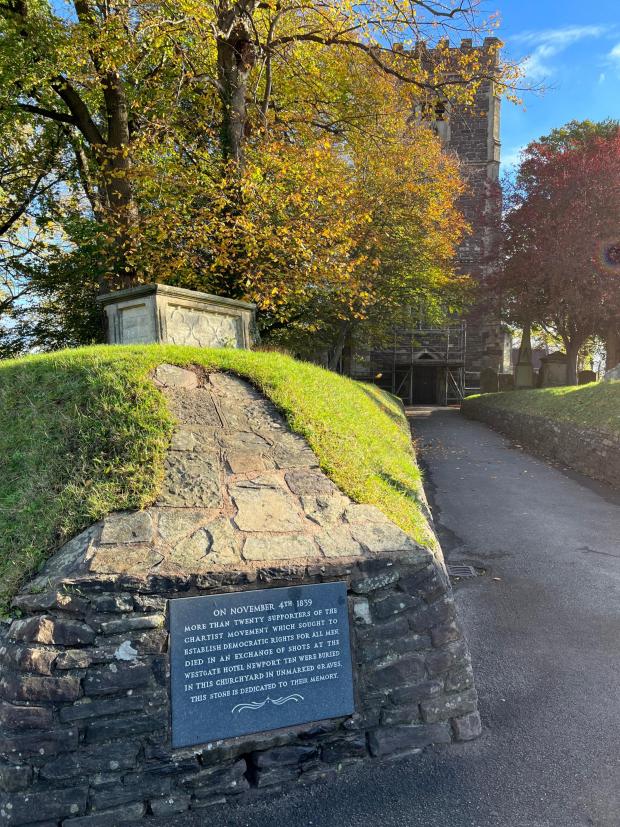
Sadly another memorial commemorating the lives of some of the Chartists was vandalised, just days before the 182nd anniversary of the historic uprising. The memorial is at the entrance of Newport Cathedral, the location where 10 of the Chartists who died after being shot outside Westgate Hotel at the culmination of the march on November 4, 1839, are buried in unmarked graves – and was vandalised on Tuesday, November 2, it has since been swiftly removed by Newport City Council.
Though  the rebellion failed to ignite wider revolt, it highlighted workers' desperation and fuelled long-term reforms (e.g., eventual suffrage extensions). Long may the Chartists struggle and its leaders be remembered who helped give voice to the discontent of the time in their struggle for democracy.  
 
South Wales Argus: Newport City Council cleaned the graffiti from the memorial


Tuesday, 11 April 2023

Remembering Tom Hurndall , Peace Activist (27 November 1981 – 13 January 2004)


Twenty years ago on April 11 2003 Tom Hurndall  a young peace activist from North London was shot in the head by an Israeli military sniper as he was rescuing several small children from Israeli gunfire,
Thomas “Tom” Hurndall was an aspiring photojournalist who put himself at the service of the world. In 2002, he traveled through Europe, eventually making his way to Jordan and Egypt where he felt intrigued by the mix of cultures. In early 2003, he joined the anti-war movement against the invasion of Iraq and physically moved there. But as the invasion became more and more likely, he moved to Jordan to help provide medical services to Iraqi refugees. There, he discovered the International Solidarity Movement (ISM),  an organisation that use non-violent protest against the Israeli military in the West Bank and Gaza Strip,
On the 6th April.2003 as a photojournalist, hoping to document Palestinians' oppressive living conditions he moved to Rafah in the Gaza Strip.and not long after he began emailing images of the IDF and the Palestinians back to his family. In his Guardian obituary it says “the tone of his journals changed dramatically” with his arrival in Palestine.
Tom even wrote of the death of Rachel Corrie, who had been crushed to death by an Israeli defence force bulldozer while acting as a human shield near the Rafah refugee camp.https://teifidancer-teifidancer.blogspot.com/2023/03/courage-to-resist-remembering-rachel.html
“I wonder how few or many people heard it on the news and just counted it as another death, just another number … ” wrote Tom.
  On   11th of April Tom and  and a group of activists were in the area of Rafah with the intention of setting up a peace tent on one of the nearby roads to block the IDF tank patrols, it was then that Israeli Sbipers started shooting.   As all ran for cover, Tom noticed that three of the many children previously playing in the road had become paralyzed with fear. Tom dashed towards one of the children and brought him to safety. He turned back to rescue another child, but as he approached, Israeli sharpshooter Taysir Hayb fired a round into his skull. Tom hit the ground bleeding, less than a week after moving to Palestine.
 At the time of the shooting Tom was in plain view of the sniper towers and was wearing a bright orange fluorescent jacket with reflective stripes and was clearly unarmed. According to other ISM activists “there was no shooting or resistance coming from the Palestinian side at all.” It is also reported that an ambulance came very quickly, about 2 minutes after the shooting..
After a  two  hour delay at the border of the Gaza strip, Tom’s ambulance was finally allowed through. Tom received emergency treatment in Be’ersheva Hospital before being transferring to London where he remained in a coma for nine months. He died on January 13, 2004  at the tender age of 22.
A year after his death, following the family's own investigation and their determined and impartial fight to see justice done after a cover-up by the Israeli Defence Force, Wahid Taysir Al Heib, the soldier who shot him was convicted of manslaughter and sentenced to  eight years for Tom's manslaughter. It was an unprecedented outcome, and a case that made legal history in bringing the IDF to account for its killing of an unarmed civilian. 
Hayb was released on September 8, 2010, only having served six and a half years of his sentence after an army committe concluded that he “no longer posed any threat to society in their view..
n 10 April 2006, a British inquest jury at St Pancras coroner’s court in London found that Hurndall had been “unlawfully killed”and found that the killing was intentional – in other words, murder.. Tom's  father told reporters that there had been a “general policy” to shoot civilians in the area without fear of retaliation, as stated by the soldier who fired the shot, Taysir Hayb. Hayb had earlier told a military tribunal that the Israeli army “fires freely in Rafah.”
On  January 10th, 2004, Jocelyn Hurndall, Tom’s mother, wrote a commentary in The Guardian, which stated: It seems that life is cheap in the occupied territories. Different value attached to life depends on whether the victim happens to be Israeli, international or Palestinian.”
 Tom’s shooting followed the murder of Rachel Corrie, run over by a bulldozer on the 16th March, and the near fatal shooting of Brian Avery, shot in the face in Jenin on April 5th.  Later that month, another Brit, filmmaker James Miller, was also killed by a sniper in Rafah. The Israeli military have refused to accept any responsibility for what they did to Rachel, Brian or James,
Tom's bravery and compassion should not be forgotten. Neither should the daily struggles of Gaza's Palestinians that he was working to show the world. since his death the occupation and oppression has got worse as apartheid Israel continue to lay siege on Gaza's 2 million inhabitants.
An annual lecture has been established to memorialise Tom's life, and to celebrate the ideals that he supported. Tom's mother Jocelyn Hurndall has also written a  powerful biography of him called ,My Son Tom: The Life and Tragic Death of Tom Hurndall. It is an elegy for a son, full of loss but also of hope. Written with honesty, dignity and insight, this moving story of a remarkable young man, a mother's love, and a devoted family gives a human face to a conflict that, directly and indirectly, affects us all.
On 13 October 2008, Channel 4 broadcast a dramatised documentary The Shooting of Thomas Hurndall,[18] which was written by Simon Block and directed by Rowan Joffe. Stephen Dillane plays Anthony Hurndall and Kerry Fox plays Jocelyn Hurndall. Anthony and Jocelyn Hurndall were interviewed at length in The Observer prior to the airing of the documentary:Hurndall.
Tom had been in Palestine for less than ten days before his life was ended by the murderers of the Israeli army. If it had not been for them, his work would no doubt have developed and grown. Like thousands of Palestinians, who do not have books devoted to their final works, his life was brutally cut short.
Toml kept a journal throughout his travels which are collected in. The Only House Left Standing:The Middle East Journals of Tom Hurndall in which he wrote discerningly about the injustices he had witnessed in Gaxa  that had a profound effect on him/ in one of his final entries he wrote  “What do I want from this life? What makes you happy is not enough. All the things that satisfy our instincts only satisfy the animal in us. I want to be proud of myself. I want more. I want to look up to myself and when I die, I want to smile because of the things I have done, not cry for the things I haven’t done.” 
 His commitment, courage, and love of life reminds us of the universality of human rights for all peoples – Tom’s decision to drop everything and go to Gaza to stand by Palestinians there, his generous gesture, encapsulates these principles. Tom remains a symbol of humanity, bravery and solidarity..His memory will live on forever.

Sunday, 20 November 2016

Jose Buenaventura Durruti ( 14/7/1896 - 20/10/36) - A New World in our Hearts


With forty years of  fighting, of exile, of jailings, of living underground, of strikes, and of insurrection, Beunaventura Durutti, the  legendary Spanish revolutionary and Anarchist lived many lives. Uncompromising, intransigent revolutionary, he travelled a long road from rebellious young worker to the man who refused all bureacratic positions, honours, awards, and who at death was mourned by millions of women and men. Durutti believed and lived his belief that revolution and freedom were inseperable. 
He was born 14 July 1896 in León, northwest Spain, as the second of eight boys born to Anastasia Dumangue, and Santiago Durruti, a railway worker and self-described socialist. Aged 14 he leaves school to become a trainee mechanic in the railway with his father. The pair became members of the UGT, Unión General de Trabajadores (socialist General Workers Union). This quiet start to life changed in August 1917, when the UGT took part in a strike, when the government struck down an agreement between unions and their employers. This soon became a general strike throughout the area. The government brought in the army and within three days the strikers had been crushed. The troops behaved with extreme brutality, killing 70 and wounding 500 workers. 2,000 strikers were jailed.  without being tried for any crime. 
Young Durruti managed to  escape the fighting, and exiled himself to France for safety, where he  came into contact with exiled anarchists, whose influence led to him joining the anarchist CNT union upon his return in January 1919. He joins the fight against dictatorial employers in the Asturian mines and is arrested for the first time in March 1919; he escapes and over the next decade and a half he throws himself into activity for the CNT and for the anarchist movement. 
These years see him involved in several strikes and being forced into exile. Unwittingly the Spanish government ‘exported’ rebellion, as Durruti and his close friend Francisco Ascaso happily joined the struggle for freedom wherever they ended up, in both Europe and Latin America. 
The Spanish monarchy fell in 1931 and Durruti moved to Barcelona; accompanied by his French companion Emilienne, pregnant with their daughter Colette. He joined the Iberian Anarchist Federation (FAI), a specifically anarchist organization, and together with other militants they form the ‘Nosotros’ group. These were members within the CNT of a radical tendency that harboured no illusions with respect to the recently proclaimed Republic, maintaining that the moment was ripe for continued progress towards a social revolution. 
With the electoral victory by the liberal/reformist Popular Front in February 1936, Left and Right were on a collision course, initiated very rapidly by Franco’s military rebellion on July 19th 1936. The CNT and the FAI confronted the army with courage, organization and mass mobilizations. 
They triumphed in much of Spain despite the fascist superiority in weapons and resources. The anarchist contribution was decisive in resisting the fascists throughout the country and in Catalonia defeated the rebels singlehandedly, Durruti being one of the boldest fighters in this battle.
 Jose Buenaventura Durruti, always fought for the poor and downtrodden, and against the State, whether of the social democratic, fascist or marxist varieties When Spanish fascists attempted to overthrow  the  Republican government on July 19th 1936, Durruti and other comrades helped put down the uprising in Barclenoa. He became a member of  the Anti fascist Militia Committee and led the "Durruti" Column an almost  mythical  group of CNT militants to the  Zaragoza front. The Durruti column was able to liberate  much of Aragon. He  was an inspiration to many as a partisan of the Spanish people with an internationalist vision, who for him personally revolutionary thought and action went hand in hand. 
In 1936, after the liberation of Aragon from Franco's forces, Durruti was interviewed by Pierre van Paasen of the Toronto Star. In this interview he gives his views on Fascism, government and social revolution despite the fact that his remarks have only been reported in English - and were never actually written down by him in his native Spanish, well worth reading and can be found here https://libcom.org/history/buenaventura-durruti-interview-pierre-van-paasen 
At the beginning of November 1936, Franco's four armies, made up mostly of Moroccans and Legionaires, converged on Madrid. The battle began on November 8th. It was basically a struggle between a well-equipped army supported by German and Italian bombers on one side, and an ill-armed mass of urban workers on the other. There were many women fighting on the republican side. Moreover, in Madrid the Communists were relatively stronger and better organised; they were also supported by various International Brigades. 
The battle continued unabated. Franco said that he would rather destroy Madrid completely than leave it to the Marxists. German Nazi troops of the Condor Legion planned to set the city on fire, quarter by quarter. On 14th November Durutti arrived in Madrid  from Aragon,by air with 5,000 men (numbers vary according to different accounts). 
The column had to go by train as all the railway tracks had been bombed. He went  to the frontline on the 16th. From November 16th onwards Madrid was bombed by German planes day and night. In three nights alone over 1,000 people were killed by the bombs. Furthermore, Madrid was cut off from the rest of Spain. In this situation of desperate crisis, Durruti decided to move 4,000 members of his Column from Aragon across the country to help relieve Madrid. 
His arrival had a tremendous effect on the besieged workers of the city. It saved Madrid, at least for a while. But tragically on November 19th, just as he was getting out of a car, he was shot  by a sniper, receiving a bullet to his chest, as he rallied his militia  to continue their resistance after days of fighting without respite. he died the following day, at the age of 40.  His death was a tragedy for all free thinkers, in the fight against fascist tyranny. His death was also a turning point in the Spanish Revolution and one of the events that lead to the defeat of the revolution. 
His body was returned to Barcelona accompanied by a number of his closest comrades. with over 500,000  people taking to the streets on November 22 1936  to follow his funeral procession, the  biggest funeral in Spanish history, a tribute to the place he played in peoples hearts, his coffin draped with the familiar diagonal red and black flag. A hero to the Spanish working class ,and today Durruti remains a lasting icon of anarchism, both in Spain and around the world, a man who.was determined to leave this world a better place than when he entered it. With the rise again of the far right, no better  time than to remember this inspirational man who died fighting against fascism in the Spanish Civil War. Many years later "we carry a new world, here in our hearts."

                        
Durruti's grave at Montjuïc Cemetery, Barcelona

Further reading:-

Daniel Guerin - No Gods, no masters; 2006

Durruti - The people Armed - Abel Paz

Durruti in the Spanish Revolution - Abel Paz 

Spanish Civil War  (1936-37) (Buenaventura Durruti)

Spanish Revolution 1936-1937 (Buenaventura Durruti)


The film above shows the period of revolution that gave in Spain in the years of civil war, and  highlights the hero killed by the bourgeoisie (Buenaventura Durruti).and how social peace was achieved thanks to the collectivization of land and the elimination of social classes.

Living Utopia - The Anarchists and the Spanish  Revolution

Living Utopia is a unique documentary that blends the historical account of the origins and development of the Spanish anarchist movement, focussing on the 1936 war. A reflection on the philosophical underpinnings of such a movement and their practical application. As both an informative and inspiring piece of research it is considered a jewel amongst historians and rebel hearts.
This documentary-film by Juan Gamero consists of 30 interviews with survivors of the 1936-1939 Spanish Revolution, and is one of the best documentaries dealing with the theme. The testimony of the anarchist militants are very moving indeed, and are showing the constructive work of the social revolution in Spain. This "Anarchy in Action" meant: on the land around 7 million peasants form collectives, in the city 3000 workplaces collectivised, 150 000 join the anarchist militias to fight fascism, as well as cultural activities and the movement of the Mujeres Libres to free the women from patriarchy.

Spanish with english subtitles


"  We  have always  loved in slums and holes in the wall. We will  know how to accommodate ourselves for  time. For you must not forget we can also build. It is we who built the palaces and cities here in Spain and America and everywhere. We the workers, can build others to take their place. And better ones. We are not in the  least afraid of ruins. We are going to inherit the earth. There is  not the slightest  doubt about that. The bourgeoisie might blast and ruin its own world before it leaves the stage of history. We carry a new world, here in our hearts. That world is growing every minute."

-Jose Buenaventura Durruti , Spain, Aragon , 1936
 

Monday, 23 November 2020

Beunaventarra Durruti laid to rest (14/7/1889 - 20/11/1936)


With forty years of  fighting, of exile, of jailings, of living underground, of strikes, and of insurrection, Beunaventura Durutti, the  legendary Spanish revolutionary and Anarchist lived many lives. Uncompromising, intransigent revolutionary, he travelled a long road from rebellious young worker to the man who refused all bureacratic positions, honours, awards, and who at death was mourned by millions of women and men. Durutti believed and lived his belief that revolution and freedom were inseperable. 
He was born the son of a railway worker on July 14th 1896 in Leon, a city in central Spain. Aged 14 he leaves school to become a trainee mechanic in the railway yard. Like his father, he joins the socialist UGT union. He takes an active part in the strike of August 1917 when the government overturned an agreement between the union and the employers. This soon became a general strike throughout the area. The government brought in the army and within three days the strikers had been crushed. The troops behaved with extreme brutality, killing 70 and wounding 500 workers. 2,000 strikers were jailed. 
Durruti managed to escape to France, where he came into contact with exiled anarchists, whose influence led to him joining the anarchist CNT union upon his return in January 1919. He joins the fight against dictatorial employers in the Asturian mines and is arrested for the first time in March 1919; he escapes and over the next decade and a half he throws himself into activity for the CNT and for the anarchist movement. 
These years see him involved in several strikes and being forced into exile. Unwittingly the Spanish government ‘exported’ rebellion, as Durruti and his close friend Francisco Ascaso happily joined the struggle for freedom wherever they ended up, in both Europe and Latin America. 
The Spanish monarchy fell in 1931 and Durruti moved to Barcelona; accompanied by his French companion Emilienne, pregnant with their daughter Colette. He joined the Iberian Anarchist Federation (FAI), a specifically anarchist organization, and together with other militants they form the ‘Nosotros’ group. These were members within the CNT of a radical tendency that harboured no illusions with respect to the recently proclaimed Republic, maintaining that the moment was ripe for continued progress towards a social revolution. 
With the electoral victory by the liberal/reformist Popular Front in February 1936, Left and Right were on a collision course, initiated very rapidly by Franco’s military rebellion on July 19th 1936. The CNT and the FAI confronted the army with courage, organization and mass mobilizations. 
They triumphed in much of Spain despite the fascist superiority in weapons and resources. The anarchist contribution was decisive in resisting the fascists throughout the country and in Catalonia defeated the rebels singlehandedly, Durruti being one of the boldest fighters in this battle.
 Jose Buenaventura Durruti, always fought for the poor and downtrodden, and against the State, whether of the social democratic, fascist or marxist varieties When Spanish fascists attempted to overthrow  the  Republican government on July 19th 1936, Durruti and other comrades helped put down the uprising in Barclenoa. He became a member of  the Anti fascist Militia Committee and led the "Durruti" Column an almost  mythical  group of CNT militants to the  Zaragoza front. The Durruti column was able to liberate  much of Aragon. He  was an inspiration to many as a partisan of the Spanish people with an internationalist vision, who for him personally revolutionary thought and action went hand in hand. 
In 1936, after the liberation of Aragon from Franco's forces, Durruti was interviewed by Pierre van Paasen of the Toronto Star. In this interview he gives his views on Fascism, government and social revolution despite the fact that his remarks have only been reported in English - and were never actually written down by him in his native Spanish, well worth reading and can be found here https://libcom.org/history/buenaventura-durruti-interview-pierre-van-paasen 
 On 14th November Durutti arrived in Madrid at the height of the  civil war from Aragon,by air with 5,000 men( numbers vary according to different accounts). The column had to go by train as all the railway tracks had been bombed. He went  to the frontline on the 16th.
Tragically Durruti on the 19th November  1936, he was shot dead  by a sniper, receiving a bullet to his chest, as he rallied his militia  to continue their resistance after days of fighting without respite. he died the following day, at the age of 40.  His death was a tragedy for all free thinkers, in the fight against fascist tyranny. His death was also a turning point in the Spanish Revolution and one of the events that lead to the defeat of the revolution. 
When his body was returned to Barcelona  over 500,000  people took to the streets on this day November 23 1936  to follow his funeral procession, the  biggest funeral in Spanish history, a tribute to the place he played in peoples hearts, his coffin draped with the familiar diagonal red and black flag. A hero to the Spanish working class ,and today  Durruti remains a lasting icon of anarchism, both in Spain and around the world, a man  who.was determined to leave this world a better place than when he entered it. With the rise again of the far right, no better  time than to remember this inspirational man who died fighting against fascism in the Spanish Civil War.

Rare footage of Beunaventura Durutti's funeral.


This book is his definite biography :

https://libcom.org/library/durruti-spanish-revolution

 Further reading:-

Daniel Guerin - No Gods, no masters; 2006

Durruti - The people Armed - Abel Paz

   "  We  have always  loved in slums and holes in the wall. We will  know how to accommodate ourselves for  time. For you must not forget we can also build. It is we who built the palaces and cities here in Spain and America and everywhere. We the workers, can build others to take their place. And better ones. We are not in the  least afraid of ruins. We are going to inherit the earth. There is  not the slightest  doubt about that. The bourgeoisie might blast and ruin its own world before it leaves the stage of history. We carry a new world, here in our hearts. That world is growing every minute."-  Beunaventarra Durruti

Spain, Aragon , 1936


Saturday, 15 January 2022

Hurrah for the Blackshirts : Remembering The Daily Mail's Support For Fascism


On January 15 1934, The Daily Mail newspaper ran with the notorious headline “Hurrah for the Blackshirts” which was written by Viscount Rothemere, whose family incidentally still own the Mail, an article that  celebrated Oswald Mosley and the British Union of Fascists (BUF).
Mosley was highly influenced by Benito Mussolini, so much so that members of the BUF were given the nickname of ‘Blackshirts’ as their uniform was modelled on that worn by those belonging to the National Fascist Party in Italy.Mosley’s Blackshirts dressed up like Mussolini’s thugs and saluted like Hitler’s, but theirs was a distinctly English program. The first of Mosley’s “10 Points of Fascism” announced that the BUF was “loyal to King and Country” and its “watch-word… is ‘Britain First.’”
 Mosley himself was commissioned in the 16th Lancers but joined the Royal Flying Corps at the outbreak of the First World War. Injured in a crash in 1915, he rejoined the Lancers and fought in the trenches between October 1915 and October 1916. He joined the Conservatives after military service to become an MP at 22. From the first, he challenged the old guard even within his own party, and was re-elected as an Independent before crossing the House to join Labour where he campaigned on unemployment. With his matinee idol looks and dramatic oratory, Mosley cut a darkly glamorous, radical figure.After the 1931 general election, Mosley toured Europe and it was that particular expedition which drew his attention to fascism. Following his travels, at 34 he founded the New Party, which – influenced by Mussolini – morphed into the quasi-military British Union of Fascists 19 months later in October 1932, with Mosley himself as the leader.


 Lord Rothermere, had launched the Daily Mail in 1896 with his elder brother, Alfred Harmsworth, who was later named Lord Northcliffe. By 1930, they owned 14 daily and Sunday newspapers, and a substantial share in three more.Shortly after Mussolini came to power, Rothermere laid his cards on the table. In an article in the Mail entitled “What Europe Owes to Mussolini,” he expressed his “profound admiration” for Italy’s new leader.
“In saving Italy he stopped the inroads of Bolshevism which would have left Europe in ruins… in my judgment he saved the whole Western world,” Rothermere declared.
His frequent visits to Italy seemed only to further stoke Rothermere’s enthusiasm for the Duce.
He is the greatest figure of the age,” Rothermere proclaimed in 1928. “Mussolini will probably dominate the history of the 20th century as Napoleon dominated that of the early 19th.” He praised Mosley and the Blackshirts seeing them as the correct party to “take over responsibility for [British] national affairs”.
 Rothermere initially believed that Britain was “not suited” to fascism, but a general strike in 1926 and a fear that Baldwin was displaying “the feebleness which tries to placate opposition by being more socialist than the Socialists,” led him to reappraise this view as a new decade dawned.
 The Mail’s enthusiasm for the Nazis would grow as their support in Germany surged.By the 1930 election, when the Nazis’ seats in the Reichstag jumped from 12 to 107, Rothermere was a convert.
“[The Nazis] represent the rebirth of Germany as a nation,” Rothermere wrote in the Mail. The election, he correctly prophesied, would come to be seen as “a landmark of this time.”
It wasn’t hard to see why the Mail’s fawning coverage of the Nazis so delighted the Fuhrer — the paper uncritically reported the butchery of the Night of the Long Knives.
Herr Adolf Hitler, the German Chancellor, has saved his country,” began its story on the frenzy of extrajudicial killings, and cheered the Nazis on as they trampled the provisions of the Treaty of Versailles.
When German troops marched into the Rhineland in March 1936, the Mail suggested Hitler had “cleared the air” and warned against “Bolshevik troublemakers.” It offered a glowing report of the Anschluss two years later — penned by Price, who had hitched a ride in Hitler’s convoy as it sped towards Vienna.
 Grateful for this unusual support from the foreign press,gained the Mail exclusive access to publish interviews with Hitler, it also earned Lord Rothermere and his son a place at the dinner table as honoured guests of Hitler himself.Following his meetings, Rothermere believed Hitler — a “simple and unaffected man” and a “perfect gentleman” — to be “obviously sincere” in his desire for peace. “There is no man living whose promise given in regard to something of real moment I would sooner take,” he later argued. A vicious reactionary anti-semite, Rothermere saw the Nazi dictator as an ally against the spread of (Jewish) communism and backed Hitler's actions to remove Jews from public life in Germany. During the Munich crisis of 1938 his papers urged capitulation to Hitler's demands for the German-speaking regions of Czechoslovakia (though they did advocate rearmament, just in case). The Mail objected time and again to the admission to Britain of Jewish refugees from Germany and Austria. 


                                                      Lord Rothermore and Hitler

Under the headline Hurrah for the Blackshirts Rothermore praised Mosley and the Blackshirts seeing them as the correct party to “take over responsibility for [British] national affairs”;auding Mosley’s aim of bringing Britain “up to date” by following in the footsteps of Europe’s “best governed” nations, Italy and Nazi Germany. The article urged a similar “revival of national strength and spirit.” Following their proprietor’s cue, staff at the paper began showing up for work wearing black shirts.
Rothermere’s other newspapers also threw their support behind the effort. The Mirror urged its readers to “Give the Blackshirts a helping hand,” and printed the addresses of Mosley’s local recruiting offices. A visit to Germany or Italy, Rothermere assured readers, showed that “the mood of the vast majority of the inhabitants was not cowed submission, but confident enthusiasm.
The Sunday Dispatch offered free tickets to Mosley’s rallies, prizes for readers who submitted letters on why they liked the Blackshirts, and regular features on attractive female fascists, under headlines such as “Beauty joins the Blackshirts.”
 By 1936 anti-semitic assaults by fascists were growing and windows of Jewish-owned businesses were routinely smashed. Hurrah for the Blackshirts!’  The Daily Mail headline is just one chilling indication of the very real threat Oswald Mosley’s British Union of Fascists posed in the mid 1930s which concluded with a direct call for young men to join Oswald’s party.and  certainly helped boost  the BUF membership considerably, perhaps to as many as 50,000 active members..
 When, on 7 June 1934, Oswald Mosley addressed a tumultuous rally at London's Olympia, his British Union of Fascists seemed on the verge of political acceptability. Yet with its chaos, violence and subsequent condemnation in the press, Olympia marked the beginning of the end for the Blackshirts.
Mosley’s blackshirts had been harassing the sizeable Jewish population in the East End all through the 1930s and a primary focus of its anti-immigrant and antisemitic sentiment was Stepney, an East End neighborhood then home to 60,000 Jews descended from families who fled pogroms in Russia and Eastern Europe, as well as Irish and other immigrant workers. and on 4th October 1936, Mosley planned the BUF’s biggest and boldest initiative yet. His uniformed Blackshirts would march through London’s East End, home to one of the country’s largest Jewish communities. The intention was quite clear: to cause fear and stir up hate. On the day, more than a hundred thousand east enders, of any faith or none, turned out to protect their community. The fascists were forced to retreat in what became known  as the Battle of Cable Street https://teifidancer-teifidancer.blogspot.com/2021/10/remember-battle-of-cable-street-no.html. in which tens of thousands of anti-fascists  battled 6,000 police and 3,000 BUF Blackshirts to refuse the fascists passage through Stepney. Taking their example from Spanish Communists during the siege of Madrid months earlier, they used as their slogan “¡No pasarán” and erected three sets of barricades on Cable Street. Irish dockworkers tore up paving stones and filled the street with broken glass and marbles to defeat mounted police. They did, not pass.


Mosley lost thousands of supporters as people began to make links between what was happening at home and events in Nazi Germany.s the Second World War loomed,.and during the Second World War, the British authorities viewed Mosley as an enemy sympathiser – if the Nazis successfully invaded the UK, it was believed he would head up the regime on home soil – and had him interned, along with his wife. The pair lived together in the grounds of Holloway prison for the majority of the war, before being released in 1943.After the war, Mosley formed the Union Movement in 1948, but his influence had waned.and The Union Movement was eventually dissolved in 1973 after failing to gain significant ground.
The Daily Mail began to change its editorial line and moved away from explicitly supporting fascists and their regimes. But, the racism and xenophobia remained a key part of their  so called ‘journalism’ and has continued through to this day. Rothermere died in 1940 a broken man, desperately disappointed that the great dictator in Berlin had not forged an alliance with London to vanquish Stalin. He was an utterly disgusting human being..
The forces of Fascism are on the rise again, in Europe and around the world.we must continue to resist wherever they are promote and try to come together. Those who daub synagogues with anti-semitic graffiti or defile mosques with anti-Islamic hate or any other communities that suffer abuse or racism, we  must  forever be on the side of those communities, and they will never be given any welcome, and be outnumbered and humiliated by antifascists. Whilst they continue to intimidate and stoke up division with their racist ideology and their  hatred against difference and people marked as socially undesirable. they  will always be met with resistance, their routes blocked by those that seek to defend their communities from fascist violence.
Sill a high-circulation right-wing tabloid much beloved by “Middle England” The Daily Mail still weathers the occasional barbs about its disreputable past whilst creating hate-filled media stories that create a violent culture of hostility towards migrants and refugees. Remember Rothermere was pro-Nazi. The Daily Mail was pro-Nazi. The Daily Mail is the traitors' paper. Never forget, never forgive. Lower than vermin, as Aneurin Bevan once said. 
 
 Daily Mail Poem

I pour scorn on its petty margins
Its distortion of realities silhouette,
The daily shame, should be its new name
Cross out all its lies, we'd be left with empty pages,
Drinking toasts to underbellies of nastiness
It sharpens its pen on bile,
With agenda of spreading hatred
Is enough to scramble your brain,.
A bully that's scared of everything
Its dark heart  distorts reality,
With script of venom and division
In truth, worth nothing at all,
Its pinning sense of intolerance
Is a message I don't want to hear,
A tabloid  rag not fit for the gutter
Full of twisted opinion and bad news
Designed to leave us disheartened,
Don't know how anyone can call it a friend.