Since January, 2018 Newsnight has found a shocking 90 cases where child asylum seekers have been incorrectly classified as adults.
In the above report, Helen Johnson OBE, of The Refugee Council 's Head Of Children's Service, explains how children whose age is not believed are locked up by immigration officers in adult detention centres in breach of Government policies and legal guidelines.. This has a devastating impact on vulnerable and traumatised young people who came to the UK in the hope of finding safety. Children experience severe physical and emotional effects of detention, which is traumatic and can last a lifetime.
The mistakes continue to happen. Government records show that at least
five children have been detained in the notorious Yarl’s Wood centre in
Bedfordshire since the start of 2015. Three of them were eventually
classified as between 12 and 16 years old.
Procedures at Yarl’s Wood have also been criticised by the Chief
Inspector of Prisons. In 2013, official inspectors wrote in a report on
the centre that “some young detainees were age assessed by a chief
immigration officer, rather than social services”.
Once inside an adult detention centre, children have struggled
to challenge the Home Office’s decision. Many have been left waiting
for months to be seen by councils’ child experts.
Holding children under the same conditions as adults are held is inhumane, and must come to an end, they should all be afforded appropriate
care and protection they truly deseve.
To find out more, read Navid's story below or discover how the Age Disputes Project is helping these chidren get the support they desperately need.
May Day, the 1st of May marks an ancient northern hemisphere spring festival and a traditopnal speing festival in many cultures around the globe. With the earliest May Day celebrations appearing with the Floralia,
festival of Flora, the Roman goddess of flowers. During the Roman
Republic era, this was held on April 27 and with the Walpurgis Night
celebrations of the Germanic countries. It is also associated with the
Gaelic Beltane, which is most commonly held on April 30.The day
was originally a traditional summer holiday in many European pagan
cultures, as February 1 used to mark the first day of spring, therefore
May 1 celebrated the first day of summer, thus the summer solstice in
June 25 was Midsummer.
When Europe became Christianised, May Day changed into a popular
secular celebration and the secular versions observed both in Europe and
North America incorporated the traditional dancing around the maypole
and crowning the Queen of May.
The giving of ‘May baskets’, small
baskets of sweets or flowers which were usually left anonymously on
neighbours' doorsteps, were also a traditional part of May Day, but have
now faded in popularity since the late 20th century.
Today also marks a neo-pagan festival, Beltane, the Celtic festival of
Summer's beginning a time to dance under a Maypole, a time of cleansing
and renewal,drink and be merry, follow Jack in the Green, the mystical
Green Man of legend.
Although the secularisation of May Day was due to the pagan holidays
losing their religious character, during the late 20th century many
neopagans began reconstructing traditions and began again celebrating
May Day as a religious pagan festival.
May Day traditions in the UK also involve crowning a May Queen and
dancing around a maypole, where traditional dancers circle around with
brightly coloured ribbons. Historically, Morris dancing has also been linked to May Day celebrations.
May Day May Day has been a traditional day of festivities for many centuries,
usually in small towns and villages, with people celebrating springtime
fertility of the soil, livestock, and people.
May Day is also now recognised symbolically all over the world as
International Workers Day or Labor Day. It is a day for the working class to down
tools and take to the streets in protest against capitalism and wage
slavery. We should not forget Chigago , Haymarket either, where on May
4, 1886, demands for an eight hour working week became particularly
intense. Where a labour demonstration caused a crowd of some 1,500 people to gather. When policemen tried to
disperse the meeting, a bomb exploded and the police opened fire on the
crowd. At least eight people died as a result of the violence that day and more than 100 people were injured. Eight leading Chicago
anarchists were subsequently arrested, and charged with the bombing,
despite no evidence of their involvement, five were sentenced to be
hanged, two were given life sentences and the last was sentenced to 15
years in prison. The trial is now known by legal historians as one of
the worst miscarriages of American history and spared an international wave of protest,.
In December 1888 the American Federation of Labour called a protest for 1 May 1890 and in 1889 the founding meeting in Paris by what is known as the congress of the Second International Workingman's association took up the call for a "great international demonstration" to take place the following year, The call was a resounding success. The International had already decided to begin a campaign for the 'three eights'--eight hours work, eight hours leisure and eight hours sleep. The causes of the eight hour day and the Chicago Martyrs were tied together, and May Day was launched.
The Second International meant business. It called not just for protests, but for international strike action on 1 May 1890. It was decided that the day would symbolise not just the struggle for an eight hour day, but the international power of the organised working class.
That first May Day in 1890 thousands of workers stopped work and took to the streets in Germany, there were mass strikes in Italy, and in Cuba the cigar workers struck. In Britain 10,000 workers marched behind a temperance band in Northampton, and in London there was a huge demonstration of 500,000 people. Observing it, Engels commented that he had heard 'for the first time in 40 years, the unmistakable voice of the English proletariat'.
May Day soon developed into a truly international workers' day. At the Hyde Park celebrations in 1904 German, Polish, Yiddish and Russian speakers were heard, reflecting the diversity of the working class movement., attracting thousands and thousands of people. On May Day 1909 the march was led off by 2,000 children from Socialist Sunday Schools singing socialist hymns and 300 Clarion cyclists wearing red roses. It has continued to
this day. Since then, May Day has become established as an annual event
to commemorate all the workers who have died in the struggle against
those who exploit them. A celebration of international struggles and our
solidarity. As workers have emerged from tyranny and repression in whatever country, they have adopted May Day as theirs. With these acts of solidarity we
also lay down the foundations of a future world.
In Britain we even
have a Bank holiday now close to the day, which was created in
1978, this year in the UK it will be May 7th. In February 2011 it was reported that
the Tories were considering scrapping the bank holiday
associated with May Day in favour of replacing it with a bank holiday in
October, possibly in order to coincide with Trafalgar Day, which thankfully
failed.
I see no reason why not to celebrate all of the above.
Happy May Day
Heddwch/peace
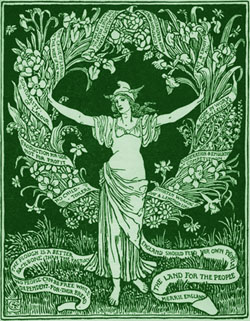
A Garland for May Day
1895, Walter Crane
The Internationale
Stand up all victims of oppression
For the tyrants fear your might
Don't cling so hard to your possessions
For you have nothing if you have no rights
Let racist ignorance be ended
For respect makes the empires fall
Freedom is merely privilege extended
Unless enjoyed by one and all
So come brothers and sisters
For the struggle carries on
The internationale
Unites the world in song
So comrades come rally
For this is the time and place
The international ideal
Unites the human race
Let no one build walls to divide us
Walls of hatred nor walls of stone
Come greet the dawn and stand beside us
We'll live together or we'll die alone
In our world poisoned by exploitation
Those who have taken now they must give
And end…
The 75 year old Ustad Naseerudin Saami is a master of the unigue Pakistani vocal style known as Surti which is characterised by its use of microtonals,
and is widely regarded as the very last master of the khayal (Arabic for
"imagination"), a pre-Islamic predecessor of Pakistani qawwali music which has been handed down by his ancestors for over a thousand years, but currently on the brink of extinction. It is multilingual (Farsi, Sanskrit, Hindi, the ancient and dead language of Vedic, gibberish, Arabic, and Urdu) music.
But because his style of music is regarded as blasphemous and considered haram, impure and resented, as they do anything else pre-dating Muhammad, and have made threats on his life for simply performing the ancient art. This has seen in Pakistan many musicians being murdered since the turn of the century. notably the assasination of the famous qawalli Anjad Sabri in a hail of bullets in 2016 and the numerous attacks on Sufi Pakistanis. Sadly, like in in Mali,this distrust has seen a violently imposed break from anything outside the doctrine and
history of Islam which has resulted in the ritual burning of instruments and a ban of
most musical forms. Master Ustad Naseeruddin Saami's however has spent his entire life mastering the nuances of every given note, in order to keep Surti alive, and it
is important to acknowledge, that when he passes, the music may die with
him. While many others would be cowed into silence, Saami remains defiant, literally risking his life daily in Pakistan.
I have finally managed to get hold of a copy of ' God Is Not A terrorist ' which was produced by acclaimed Tinariwen producer and Grammy Award winner Ian Brennan. Vol.5 of Glitterbeat’sHidden Musics series and was recorded in one single night session during which
the musicians present continuously chewed paan (a preparation combining
betel leaves with areca or betel nuts found in South Asia, South-East
Asia and Taiwan and chewed for its stimulating and psychoactive effects)
until their teeth turned a fiery red. The session yielded 5 tracks,
all featuring the harmonium or pump organ (an instrument introduced
in Asia by Christian missionaries and banned on the Indian and later
Pakistani radio for the longest time) in the leading role.
The record is a delight, the music is dense and rich and full of wailing that bends and
weaves throughout, hypnotising, raw and haunting, powerfully carrying a contemporary message celebrating peace and diversity that is truly universal. You do not need to understand the lyrics to enjoy the singing, with his soaring voice it's a truly electrifying listening experience. I especially love the message in the title track, "to sing is to listen" The highlight for me has got to be the almost twenty-minute long closing track
'Longing'. A truly mesmerizing homage to a disappearing musical tradition! Long may this music live on freely. As the Sanskrit proverb says;" If one has a diamond in their chest, it will shine on their face."Despite opposition, Master Ustad Naseeruddin Saami chooses the light.
Tracklist 1, God Is 2. My Beloved Is On The Way 3. Twilight 4. Hymn 5.War Song 6. Longing
I can't rap, in fact i'm rather crap
a light weight snowflake, not hardcore,
my poetry can arrive like a hallmark card
overworked rather tired, ever so scarred,
uninvited not making people beg for more
but sometimes brutally honest when I soar,
with a revolutionarty message to it's core
after smoking bud, mind starts to flow,
words arrive not from god or allah
from deep inside my heart to catch ya,
under the influence am not falling yet
beyond poetical rules this is what you get,
i'm not sorry, I just can't fake it
unleashed take a stand against bullshit,
cutting like razors, releasing inner edge
get too deep, don't know when to stop,
renegade thinking ,growing and knowing
rhymes released, just my way of showing,
on the battlefield try to protect peoples rights
bewildered by what I see fight against injustice,
stand wth the kurds, the palestinians, anyone not free
on the streets, on the page this is my reality,
love can arrive to act like a tranquiliser
a passion that oozes when fuse is lit,
making me stronger easing the pain
through the haze and smoke, pouring rain,
releasing my songs of pride and devotion
this is me, please accept my contradiction..
The year 2001 marked the 50th anniversary of the 1951 Convention relating
to the Status of Refugees. The UN General Assembly therefore decided
that 20 June would be celebrated as World Refugee Day from 2001 onwards.
Since then Refugee week is now a UK-wide programme of arts, cultural and educational
events and activities that celebrates the contribution of refugees to
the UK and promotes better understanding of why people seek sanctuary.
Anyone can take part by organising, attending or taking part in
activities.
This
year during Refugee Week we are invited to discover the experiences of displacement
that are found in our families, neighbourhoods and history. The theme of Refugee Week this year is, ‘You, me
and those who came before’, and is an invitation to explore the lives of
refugees – and those who have welcomed them – throughout the
generations. people escaping war and persecution have
been welcomed by communities in the UK for hundreds of years, and their
stories and contributions are all around us. From the Jewish refugees of
the 1930s to people fleeing Vietnam in the 1970s, Kosovans in the 1990s
to those arriving today; they are part of who we all are.
This year during World Refugee Week, June 16-23, 2019, people are also invited to join the Ration Challenge. You are asked to commit to eating and drinking
the same rations as a Syrian refugee living in a camp in Jordan, and the money raised will provide food, medicine and
education for refugees and people living in poverty around the world.
It’s
a tough challenge but you will be joining others raising money and awareness for refugees and showing that your with them, and not against them.
Former US Army intelligence analyst Chelsea Manning
will cruelly remain in jail after a federal appeals court on Monday denied her
request to be released on bail, and upheld a lower court's decision to
hold Manning in civil contempt for refusing to give evidencebefore a grand jury. She,now faces another further 16.5 months of incarcernation.
Manning was convicted by court-martial in 2013 of espionage and other offences for furnishing more than 700,000 documents, videos, diplomatic cables and battlefield accounts to WikiLeaks while she was an intelligence analyst in Iraq.
Former US President Barak Obama in his final days in office, commuted the final 28 years of Manning's 35-year sentence.
Manning has tried to fight the grand jury subpoena in the Assange case, citing her First, Fourth and Sixth Amendment rights under the Constitution. Manning's lawyers lawyers argued that the government was abusing the grand jury process, since she'd already disclosed everything she knew during her court-martial proceedings years ago. Following Assange's arrest, her legal team released a statement saying that holding her in jail any longer "would be purely punitive."
Manning also argued that the government should be required to reveal if they had her under surveillance, and that the district court judge had wrongly sealed parts of her contempt hearing in March. According to Manning's court briefs, a prosecutor told her lawyer that the government believed Manning gave false, contradictory, or incorrect testimony during her court-martial, and Manning's lawyers took this to mean the government had "intercepted, misunderstood, and misattributed electronic communications."
The 4th Circuit rejected all of her arguments. Manning can now ask a full sitting of the 4th Circuit to reconsider the three-judge panel's decision, or she could petition the US Supreme Court to take her case — the press release from Manning's legal team on Monday indicated she was considering both options.
"We are of course disappointed that the Circuit declined to follow clearly established law, or consider the ample evidence of grand jury abuse," Manning's attorney Moira Meltzer-Cohen said in a statement., Moira Meltzer-Cohen, suggested prosecutors were abusing "grand jury power", and that "the likely purpose of her subpoena is to help the prosecutor preview and undermine her potential testimony as a defence witness for a pending trial".Her lawyers have also argued that the courtroom was improperly sealed during substantial portions of the hearing.Manning had been held in "administrative segregation," also known as solitary confinement, for nearly a month after the contempt finding, which her lawyers protested. Her support team tweeted from her account on April 4 that she'd been moved into general population at the Truesdale Adult Detention Center in Alexandria, Virginia.
In a comment released by a spokesman, Manning said
that while disappointing, the appeals court ruling will still allow her
to "raise issues as the government continues to abuse the grand jury
process". "I don't have anything to contribute to this, or any other grand jury. While I miss home they can continue to hold me in jail, with all the consequences that brings. I will not give up. Thank you for your love and solidarity through letters and contributions,"
The fact that Manning is still in jail is one of the clearest signs that
federal prosecutors are still investigating Assange and WikiLeaks and
mulling additional charges. Assange was arrested
by United Kingdom authorities on April 11 at the Ecuadorian embassy in
London, in part because he faces an indictment in the United States that
charges him with conspiring with Manning to hack into US Defense
Department computer systems in 2010.
Blair Peach died from a broken skull on the 23rd of April 1979, as a result of being struck on the head by a truncheon wielding policeman from the Special Patrol Group during a demonstration outside Southall Town Hall, people will march in his honour in London, near a
primary school that's named after him. A plaque will also be unveiled in memory of him and Gurdeep Singh Chaggar, a local man who was killed by a racist gang in 1976.
Clement Blair Peach was born in New Zealand on the 25th of March
1946. He studied at Victoria University of Wellington and
was for a time co-editor of the Argot literary magazine with his flatmates
Dennis List and David Rutherford. He worked as a fireman and as a hospital
orderly in New Zealand before moving to London in 1969 and started working as a teacher at the Phoenix School in Bow, Towe Hamlets, East London, a special needs
school.
Peach was no stranger to radicalism
and protest; he was a member of the Socialist Worker’s Party, as well
as the Socialist Teacher’s Association and the East London Teacher’s
Association, both within the National Union of Teachers. A committed anti-fascist.In 1974 he was
acquitted of a charge of threatening behaviour after he challenged a
publican who was refusing to serve black customers. He was also involved
in campaigns against far-right and neo-Nazi groups; he was well known
for leading a successful campaign to close a National Front building in
the middle of the Bangladeshi community around Brick Lane. He was also arrested in April 1978, outside a public meeting held
by the NF in an East London school. The police had arrested a fellow
demonstrator, who was black and female. Peach instinctively placed
himself between the woman and the arresting officer and said, “Leave her
alone, she has not done anything.” He was arrested, and pleaded not
guilty but was convicted, receiving a fine of £50.
Peach was elected President of the East London Teachers Association
in 1978. Twice that year he was attacked by supporters of the National
Front as he cycled home from teaching at the Phoenix School, and he
suffered black eyes, bruising and cuts. According to the East Ender
newspaper, “Doctors fear permanent damage may have been done to one of
his eyes. His finger has been bitten through to the bone shredding the
nerves.” Even before 23 April 1979, Peach was putting his body on the line in the cause of the struggle against fascism.
On St. George’s Day 1979, the fascist National Front held a meeting in
Southall Town Hall. The Front had almost no supporters in the area, but was hoping to gain
publicity by bulldozing its way through the Asian districts of outer
London. The Anti-Nazi League held a counter demonstration
outside the Town Hall. Peach was one of 3000 people to attend. The
demonstration turned violent; over 150 people were injured, and 345 arrests were made.
Peach sustained a blow to the head from a weapon by a police officer at the junction of Beachcroft Avenue
and Orchard Avenue, as he tried to get away from the demonstration. that left him staggering in to a nearby house. The impression is sometimes given that Blair Peach died instantly in
the street but in fact he was still conscious though very dazed and
finding it hard to speak when the ambulance arrived a quarter of an hour
after the injury. There was no blood or external trauma but it’s clear
that he was suffering from a swelling in the brain, what’s termed an
extra-dural haematoma. Blair Peach died in an operating theatre at the New Ealing District Hospital at 12.10am. He was only 33 years old. At least three other anti fascist protesters were hit so hard to the head that their skulls were fractured.
Peach’s death struck a chord amongst the communities he had stood up
for, and across the city as a whole. A few days after his death, 10000
people marched past the spot where he was fatally injured. His funeral
was delayed by several months, until the 13th of June, but that was also
attended by 10000 people. The night before his funeral, 8000 Sikhs went
to see his body at the Dominion Theatre in Southall.
In the aftermath of Peach's murder, protesters were everywhere,
flyposting, speaking, organising, discussing the lessons. The police were around, in very large numbers, but they did not
dare to stop people from organising. It was almost as if the police were
shamed by the enormity of what they had done. June 1979 also saw a 2,000-strong first Black people’s march against state harassment through central London.
Police investigated themselves in the aftermath of Blair Peach's death and identified 6 cops, 1 of whom administered the fatal blow. No one has ever been charged..
The death of Blair Peach was the dire outcome of a double-edged state
racism. The police that day staunchly protected a racist gathering in a
predominantly Asian community, while unleashing militarised measures of
control and punishment on demonstrators looking to oppose the fascists
(Institute of Race Relations, 1979).http://www.irr.org.uk/
Blair Peach’s death became a focal point for those who questioned the
nature of the Special Patrol Group and the general lack of police
accountability which that force epitomised. And, from the agitation of Blair’s family, especially his long term partner Celia Stubbs, about the
inadequacy of the inquest system and the secrecy surrounding the
coroner’s court and the evidence withheld from the family, was created
the organisation INQUEST.
The Metropolitan Police commissioned an internal inquiry into what
happened, which was led by Commander John Cass. 11 witnesses saw Peach
struck by a member of the Special Patrol Group (SPG). The SPG was a
centrally-based mobile group of officers focused on combating serious
public disorder and crime that local divisions were unable to cope
with. It started in 1961, and was replaces in 1987 by the Territorial
Support Group, which also has a less-than stellar reputation amongst
activists.
The pathologist’s report concluded that Peach was not hit with a
standard issue baton, but an unauthorised weapon like a weighted rubber
cosh,or a hosepipe filled with lead shot. When Cass’ team investigated
the headquarters of the SPG, they found multiple illegal weapons
including truncheons, knives, a crowbar, and a whip. 2 SPG officers had
altered their appearance by growing or cutting facial hair since the
protest, 1 refused to take part in an identity parade, and another was
discovered to be a Nazi sympathiser. All of the officers’ uniforms were
dry-cleaned before they were presented for examination.
Cass concluded that one of 6 officers had killed Peach, but he
couldn’t be sure who exactly, because the officers had colluded to cover
up the truth. He recommended that 3 officers be charged with perverting
the course of justice, but no action was ever taken. The results of the
inquiry were not published, and the coroner at the inquest into Peach’s
death refused to allow it to be used as evidence, despite making use of
it himself. Two newspapers, the Sunday Times and the
Leveller, published leaks naming the officers that had travelled in the
van that held Peach’s killer. They were Police Constables Murray, White,
Lake, Freestone, Scottow and Richardson. When the lockers of their unit
were searched in June 1979, one officer Greville Bint was discovered to
have in his lockers Nazi regalia, bayonets and leather covered sticks.
Another constable Raymond White attempted to hide a cosh. The failure of the authorities to adeguately invstigate Peach's murder left a huge feeling of resentment. Celia Stubbs, said: "This report totally
vindicates what we have always believed - that Blair was killed by one
of six officers from Unit 1 of the Special Patrol Group whose names have
been in the public domain over all these years."
An annual award has since been presented
by the UK's National Education Union to teachers to carry on Blair Peach's memory and after his death a number of writers have dedicated poems to his memory,
including Chris Searle, Michael Rosen and Susannah Steele, Louis
Johnson, Edward Bond, Sigi Moos, Sean Hutton and Tony Dickens, and songs including the following by
dub poet Linton Kwesi Johnson in Jamaican patois.
:
Everywhere you go its the talk of the day, Everywhere you go you hear people say, That the Special Patrol them are murderers (murderers), We cant make them get no furtherer, The SPG them are murderers (murderers), We cant make them get no furtherer, Cos they killed Blair Peach the teacher, Them killed Blair Peach, the dirty bleeders.
Blair Peach was an ordinary man, Blair Peach he took a simple stand, Against the fascists and their wicked plans, So them beat him till him life was done.
Everywhere you go its the talk of the day, Everywhere you go you hear people say, That the Special Patrol them are murderers (murderers), We cant make them get no furtherer, The SPG them are murderers (murderers), We cant make them get no furtherer, Cos they killed Blair Peach the teacher, Them killed Blair Peach, the dirty bleeders.
Blair Peach was not an English man, Him come from New Zealand, Now they kill him and him dead and gone, But his memory lingers on.
Oh ye people of England, Great injustices are committed upon this land, How long will you permit them, to carry on? Is England becoming a fascist state? The answer lies at your own gate, And in the answer lies your fate.
Campaigners are now demanding a fresh inquiry into Blair Peach's death Gareth Peirce, the lawyer who defended many of those arrested in
1979, said: “Unquestionably a public investigation is required as to
what happened and why it was covered up for so long. A man was killed,
wholly innocent people were convicted and evidence against them
fabricated.
“The police went out to deliberately inflict injuries on innocent
people and were being provocative and racist. An onslaught of violence
was unleashed on the Southall community and other protesters. The
Hillsborough inquiry shows that reopening investigations into incidents
that happened in the past is not only important but achievable.”
Darcus Howe writer and anti racist activist remarked: “The death of Blair Peach is a lasting injustice. But it is also a
pressing issue because there is no evidence that the policing mistakes
that led to the death of Blair Peach have been consigned to the past.”
It is sad that battles which were fought against
state-sanctioned violence and far-right racism are still the battles being fought today, and we should not forget that Blair Peach wasn’t the first person nor the last to be killed by the police, since his murder Mark Duggan, Ian Tomlinson, Jean Charles de Menezes; are some other people who have
had the misfortune of being famous because they were killed by the
Metropolitan Police. The fight for justice goes on, as does Blair Peach's legacy who believed in the inclusion of everyone no matter what race, religion or educational ability. We must continue to confront and resist the forces of fascism and racism everywhere.