Monday, 6 May 2024

All eyes on Rafah


Emergency Protests for Rafah are  taking  place today,.Israel has chosen Yom Hashoah, the day Israel observes as a memorial for the 6 million Jews and five million others were killed by Nazi Germany and its allies in the Holocaust to  to tell hundreds of thousands of residents and displaced starving civilian Palestinian population  people in  Rafah to evacuate, fully aware that the majority of these people have nowhere to go. 
Israel dropped leaflets on the eastern areas of Rafah and ordered residents and displaced people to evacuate the areas (around 250,000 people live there)  The evacuation areas include the Rafah and Karm Abu Salem crossings, so humanitarian aid might stop flowing to Gaza at any time and the ability to travel might be impossible soon The areas designated for relocation are devastated, crowded and devoid of key services. There are no assurances of safety or return once hostilities end for those forced to relocate.
For over six months, Israel has deliberately and systematically targeted civilians and aid workers, including in clearly marked ‘safe zones’ and ‘evacuation routes.’ Any claims it now makes that civilians can be safely evacuated, have lost credibility. Al-Mawasi area - a so-called humanitarian safe zone where people have been told to flee - has already been targeted twice.
Don’t take your eyes off Rafah. Ground invasion is imminent. Another  dark chapter in Gaza genocide unfurls. If Western governments allow this to happen, there will be no coming back for humanity. The evidence that this will result in yet more death and destruction is overwhelming.
The language of "humanitarian safe zones" is completely disingenuous. Israel is a terrorist rogue state. Israel  are going to invade any minute now. We’ve reached the darkest point of the whole genocide. This is what they promised wouldn’t happen. It’s happening.  The only “safe place” left in Gaza is going to be destroyed and invaded. Palestinian people can’t evacuate quickly enough from Rafah  Experts have already  warned  us  that  an invasion of Rafah will lead to a massacre and humanitarian catastrophe for a population already facing famine.
Israel believes it can massacre with impunity because Western governments will not act: Arms. trade, military and economic aid will continue to flow to the apartheid state.  Let's  not  forget the  the six million Jewish men, women and children who were murdered during the Holocaust but  let us also remember the 34,000  Pallestinian civilians, plus the hundreds of medics, journalists, and humanitarian aid workers who have been murdered in Israel's ongoing Holocaust in Gaza. 
Israel's crackdown on Palestinian journalists makes it difficult to get coverage of what's going on.  Israel is forcibly shutting down the Al Jazeera office in Jerusalem, just as it drives over 100,000 Palestinians out of Rafah. From killing 100 plus Palestinian journalists to censoring media, Israel is trying to hide its heinous war crimes from the world..
Never forget  either that  both Starmer and Sunak not only turned their back on a clear genocide  that is happening, they supported it.They defended war crimes and blocked ceasefire motions for months  The blood will never wash clean.
The situation in Rafah is deeply concerning, and the international community must act swiftly to prevent further escalation and protect innocent lives..There hasn’t been a more urgent moment in this entire genocide  to raise our voices in unwavering solidarity and advocate for peace which matters now more than ever..
Any lever or platform., anything and everything you have.Don't look away. Call it what it is, a genocide.  Let's pray for our Palestinian brothers and sisters.  Speak up.demanding accountability from the Israeli government and justice for the victims of this senseless violence. Let us persist in our advocacy, ensuring that our elected officials hear our call for action 
We must act before more atrocities take place and press even harder for an immediate, permanent ceasefire to end the death and destruction, allow more aid into Gaza and enable  peace and justice to  prevail in Gaza. The least we can do for the Palestinians is to boycott companies that support and fund this ongoing genocide.

Website to Check the boycott brands:https://boycott.thewitness.news/

Sunday, 5 May 2024

Remembering the life of Estelle Sylvia Pankhurst Revolutionary Socialist Political Activist and Campaigner for Women’s Rights


 Estelle Sylvia Pankhurst revolutionary socialist political activist and campaigner for women’s rights, who is remembered chiefly for her use of militant tactics in the fight for women’s right to vote. was born on the  5th of  May 1882 in Old Trafford .Manchester, the second daughter of the future militant suffragette leader Emmeline Pankhurst and the radical lawyer Dr Richard Pankhurst.The family briefly located to London. When they returned to Manchester in 1893 her parents joined the Independent Labour Party and Sylvia became an activist, being particularly influenced by her father 
The Pankhurst family home was a meeting place for intellectuals and political activists, so while she was still young Pankhurst met among others Annie Besant, the American feminist Harriot Stanton Blatch, and William Morris – who exerted great artistic and political influence on her.

If you do not work for others you will not have been worth the upbringing’. 

She also acquired from her father her lifelong atheism. Sylvia’s father, Richard, died quite young in 1898 when she was sixteen. A lawyer, Richard graduated from radical Liberalism to socialism and campaigned for the progressive causes of the day. He was the architect of the Married Women’s Property Act, an important reform.Pankhurst was also profoundly influenced by her father’s progressive ideals and she strove always to live up to his admonition: 

If you do not work for others you will not have been worth the upbringing’. 

The other two members of the Pankhurst nuclear family were Sylvia’s sister Adela and her brother Harry. Adela immigrated to Australia where she became a founder member of the Communist Party, but ended up on the extreme right. Harry, a progressive for his brief life, died in 1910.
Pankhurst attended Manchester High School for Girls and trained as a scholarship student at both the Manchester Municipal School of Art and the Royal College of Art. On graduation she supported herself by selling her paintings and textile designs, and made a tour of industrial areas to paint portraits of working women. She also designed murals, banners, regalia and merchandise for the suffragette Women’s Social and Political Union, including the famous ‘Angel of Freedom’ motif.
As a young woman, she was inspired by her parents who were prominent in the labour movement. Her mother Emmeline led the Women’s Social and Political Union (WSPU), the militant suffrage organisation and from the age of 24, alongside her sister Christabel, Sylvia worked for the WSPU.Her deep feminism led to revolutionary, anti-capitalist politics and resulted in an ultimate split with her family. As a young woman she moved to London’s impoverished East End where she set up a childcare center and fought for poor women’s right to vote. Living and working among the most oppressed informed her deepening socialism, internationalism and ultimate anti-fascist work. 
After helping establish the Labour Party, Pankhurst was disgusted with its many betrayals by reformist politicians and party leaders. Winston Churchill had her physically removed from a platform where she was speaking, proclaiming he would not be “hen pecked” into supporting women’s voting rights. The extreme misogyny and violence that suffragists endured from authorities left her with a profound distrust of the entire parliamentary process. 
Her commitment to the cause was remarkable Between 1913 and 1914, Pankhurst was imprisoned 13 times. As the movement became more militant, including a mass window-breaking campaign, police stepped up their abuse. They raped, assaulted, and twisted women’s breasts, an extremely intimate form of torture. In prison, Pankhurst suffered solitary confinement, hunger strikes and forced feeding — administered orally and vaginally. Sylvia had the dubious honour of being force fed more than any other activist. She was seen by the British Secret Service as a threat to national security (apparently more so than any other suffragette), but even at this time the government was wary of bad PR. If Sylvia, or any other suffragette had died whilst in prison, their cause would have had all the greater prominence.
Accordingly, under the so called ’Cat and Mouse Act’ which was passed in 1913, prisoners weakened by hunger strikes and at risk of death could be released, and then re-arrested once they had recovered.  Despite her commitment, Sylvia’s desire for social equality was increasingly at odds with her mother and sister. Their main focus was on the suffragette cause, and they saw less value in promoting the rights of the working class in general.
In 1913, Sylvia was expelled from the WSPU and, with the help of Keir Hardie (a friend since her childhood) formed her own organisation, eventually known as the Workers Suffrage Federation (WSF). The WSF campaigned against poverty and for better social conditions, and her particular focus was on the East End of London. 
By the outbreak of war in 1914, the rift in the Pankhurst family had become a chasm. Emmeline and Christabel suspended their campaign for female suffrage, and the WSPU supported the war effort. Remarkably, there are even accounts of the WSPU handing out white feathers to those who refused to enlist. In contrast, Sylvia was a pacifist and saw the war as a means by which the ruling elite would preserve imperialism and inequality. Sylvia and other women, in the light of the WSPU’s pro-government and pro-war stance, set up the Women’s Peace Army. Sylvia became both a peace activist and a campaigner (and provider) of services for working class communities. In her work The Home Front she showed that the policy of starvation was deliberately used to boost Army recruitment. She also exposed the activities of many of those profiteering from both war and the shortage of food.
A revolutionary and world citizen,  she welcomed the Russian Revolution in 1917 and travelled there in order to assess the extent to which the Revolution liberated women. At the same time, she travelled widely throughout Western Europe to build links with other progressive forces. Her involvement in the creation of the Communist Party of Great Britain (CPGB) showed the extent to which Sylvia was prepared to argue for a particular approach. She had a robust dialogue with Lenin and although she joined the CPGB there were disagreements about the position of the Dreadnought. and was expelled from the CPGB. 
As a result of her experience Sylvia developed a much more internationalist perspective than many of her peers. She understood from the beginning that fascism in Italy was largely financed by banks and large business in order to operate in their interest. This was at a time when not only the British ruling class but many on the Left saw Mussolini as a positive development.
She began to apply her socialism to a broader analysis of fascism and to develop a critique of British Imperialism. She visited India in 1926 and wrote a book – India and the Earthly Paradise – which portrayed the brutality of the British occupation.
Sylvia was the most incarcerated and tortured of the Pankhursts, and  in 1921 she was once more His Majesty’s guest in Holloway Prison. This time her crime was not the struggle for women’s equality but sedition, in publishing anti-war articles in her newspaper the Workers’ Dreadnought.  Her health compromised by previous imprisonment and torture, and suffering from endometriosis, one of the bravest Britons of the 20th century served another prison term, this time as a newspaper publisher defending freedom of the press. 
Sylvia used her six-month solitary sentence to write.  A political prisoner, her only permitted writing materials were a small slate and chalk. Yet she was prolific during this period. On release, she published the poetry anthology Writ on Cold Slate, whose title sonnet agonizes about writing under such conditions. 

Whilst many a poet to his love hath writ, 
Boasting that thus he gave immortal life,
My faithful lines upon inconstant slate, 
Destined to swift extinction reach not thee.

Her ultimate goal was a greater level of social equality, or as some might say “social justice”. She was one of the key anti-austerity campaigners of her day. In 1923, she wrote: "Our desire is not to make poor those who today are rich, in order to put the poor in the place where the rich are now. Our desire is not to pull down the present rulers to put other rulers in their places. We wish to abolish poverty and to provide abundance for all”.  
 In 1924 Sylvia moved from the East End of London to Woodford Green, into Red Cottage with Silvio Corio, an Italian anarchist/journalist/painter and her lover and companion for 30 years. Sylvia continued to demand the vote for working class men and women (not just propertied middle class women) and this eventually came in 1928. In 1927 she give birth to her and Corio's son Richard, named for her father, whom she loved and revered,  but she also had little truck with social convention;and declined to marry  Silvio.and the birth of a child out of wedlock, widened the rift with her mother and sister, who were scandalised by the affair..
Sylvia Pankhurst had an uncompromising conviction that both individuals and communities have a shared responsibility for everybody’s welfare. She resolutely refused to differentiate between people on grounds of sex, class or colour, placing her intelligence, courage, energy and vision at the service of all. Intensely altruistic, there seemed to be no limit to the sacrifices she was willing to make for others. 
The rise of fascism in the 1930s led Pankhurst to return to active politics. She was a staunch opponent of fascism and campaigned against appeasement. Pankhurst was highly attuned to events in fascist Italy because of  her relationship  with Silvio Corio .No longer in the communist or organised labour movement, Pankhurst’s activities were as an individual, as a journalist, publicist, speaker and letter writer. 
Throughout the 1920s and 1930s she urged British politicians and opinion formers to reconsider their support for Mussolini and to question their mistaken belief in the potential effectiveness of appeasement. She constantly urged her local MP Winston Churchill to direct his attention to the danger of what was happening in Italy rather than focusing only on Germany. Those elements within the British social elites who offered enthusiastic support for Mussolini included politicians, like Churchill, the centre ‘moderate’ and right-wing press, such as the Observer – whose stated editorial policy was to support Mussolini’s continuation in power..
Pankhurst diverting her energies futilely towards influencing the bourgeoisie rather than organising amongst the working class. She moved to reformism. She admired Carlo Rosselli, who escaped from captivity in Italy, fought in the Spanish Civil War and was murdered on orders from Rome. Sylvia’s admiration of Rosselli, known for his non-Marxist ‘liberal socialism’, is indicative of the direction of her thinking at this time. The British Labour Party and radical movements had greatly influenced Rosselli’s theory of reformist liberal socialism. Sylvia read his book Socialisme Libéral, published in 1930, which contained a passionate critique of classical Marxism in favour of democratic socialist revisionism synthesizing Italian and British political thinking and practice.
Pankhurst accepted a flow of invitations from the Labour Party to speak on the menace of fascism for women. Sylvia devoted a section of her ‘Fascism as It Is’ series in New Times to ‘Women under the Nazis’.
Documenting in detail the exclusion of women from all employment by public bodies, government departments, local councils, hospitals, charities and – as far as possible – even schools, Sylvia pointed out that among the women eliminated ‘are the very people who, since the Revolution of 1918, have actually created government departments dealing with infants’ welfare and the education of girls and women’. She warned against the reaction now turning back the clock in Germany on hard-fought-for feminist advances. 
Pankhurst’s activities were not limited to speaking and writing; she and Corio undertook practical solidarity activity. For example, she founded the Women’s International Matteotti Committee which campaigned for Italian political prisoners. In 1933 Pankhurst and Corio organised an International Day of Protest ‘in support of victims of Italian fascism.’ 
The Italian fascist regime had designs for imperialist conquest in Africa. In October 1935 Italy invaded Ethiopia with overwhelming military superiority. Emperor Haile Selassie personally led stiff resistance against the odds. It took until May 1936 for Italian forces to enter Addis Ababa. Haile Selassie symbolised resistance to European colonialism. While the great powers and the League of Nations (forerunner of the UN) did nothing but impose some paltry sanctions against Italy’s aggression, in reality supporting Italy. However, there was massive support world-wide for Ethiopia. Blacks in the US, South Africans and West Africans volunteered to go to Ethiopia to fight, but were prevented from doing so. 
Pankhurst’s letter writing went into overdrive. She pilloried the inaction of the British government in letters to ‘the Manchester Guardian, The Times, Daily Telegraph, Daily Herald, Daily Express, News Chronicle and numerous local, provincial and international papers.’ On the day Addis Ababa was occupied the first issue of Pankhurst’s new venture, New Times and Ethiopia News, went to print. The first issue spelt out the paper’s position.  The cause of Ethiopia cannot be separated from the cause of international justice … We shall set ourselves resolutely to combat fascist propaganda [and], to secure the continuance and strengthening of sanctions … We shall strive to induce measures by the League to resist the fascist usurpation, and to aid and defend Ethiopia, and will persistently urge that Britain take the responsibility of initiating an active League policy … We shall urge that Britain shall herself individually give aid to Ethiopia.  
Pankhurst’s campaigning for effective sanctions on Italy contributed to pro-Ethiopia public opinion in Britain. She reported receiving daily bags of letters from women ‘thanking me for my repeated protests against the inaction of the League … and of the British Government in face of Italy’s breach of the covenant and diabolical attack on a Member State of the League.’ 
From 1936 to the outbreak of the Second World War  Sylvia saw Fascism as the antithesis of everything she believed in: it was chauvinist and militarist, whereas she was an internationalist, opposed to war; Mussolini had no truck with democracy, whereas she, like her father, believed in its extension; Fascism held that women’s primary duty was breeding soldiers for the Duce, whereas she had been a feminist all her life; and, as a Socialist, she deplored the suppression of the Italian Socialist and trade union movements. 
In October 1936 Pankhurst took part in the Battle of Cable Street, a successful mass action that prevented the fascist Blackshirts from marching through the heart of London’s Jewish East End. It was a turning point that set back fascism in Britain. Shortly after, Pankhurst spoke at a rally in the East End and was hit by one the missiles thrown by fascist thugs. 
Ger commitment to  Ethiopia continued after the war. She raised enough money to build Ethiopia’s first teaching hospital. Sylvia campaigned for liberation throughout Africa, prompting a Foreign Office official to comment in 1947 that ‘we agree with you in your evident wish that  that this horrible old harridan should be choked to death with her own pamphlets’ 
After Corio died in 1954 Sylvia accepted an earlier invitation from  her  dear  friend  Emperor Haile Selassie, Sylvia and her son Richard went to live in Ethiopia. permanently in 1956 IN  Addis  Ababa, where she edited the Ethiopia Observer  the emperor and moved with her son to live permanently in Ethiopia in 1956. There she helped to found the Social Service Society and edited a monthly periodical, the Ethiopia Observer. She was honoured with the decoration of the queen of Sheba, first class. 
Towards the end of her life Sylvia Pankhurst re-established contact with friends from the early suffrage days, including Teresa Billington-Greig, a founder member of the WSPU, who sent a copy of her autobiography to Sylvia for her comments. She had maintained a relationship with her sister Adela, who shared her socialist views, and in the 1950s Sylvia even corresponded once more with Christabel. In 1959 an exhibition of her art was held at the French Institute in London and she willingly contributed material to the organizers. Sylvia died the following year in Addis Ababa, on 27 September 1960. She was regarded so highly in Ethiopia that the emperor ordered that she should receive a state funeral, which was attended by himself and other members of the royal family. She is the only foreigner buried in front of Holy Trinity Cathedral in Addis Ababa, in a section reserved for patriots of the Italian war.  Pankhurst's name and picture (and those of 58 other women's suffrage supporters) are on the plinth of the statue of Millicent Fawcett in Parliament Square, Westminster, London.[There is a two-dimensional silhouette constructed of Corten steel representing Pankhurst as a campaigning suffragette in Mile End Park, Bethnal Green, London. She is also the subject of a mural, completed 2018 by Jerome Davenport, on the gable-end of the Lord Morpeth pub on Old Ford Road in Bow, London. It is next door to the house in which she lived between 1914 and 1924 while working with the ELFS and WSF.
In October 2022, London's Old Vic Theatre announced for 25 January 2023 the world premiere of Sylvia, a hip hop musical about Pankhurst. Directed and choreographed by Kate Prince, it seeks to tell her story to "younger and more diverse audiences".
Whether or not you agree with her politics, and with the nature of her activism, it’s hard to deny Sylvia’s role in the campaign for women and universal suffrage in the UK, and although the focus of her activities changed over time, Sylvia Pankhurst supported socialist and revolutionary politics and campaigns for women's political and sexual freedom   and  in promoting wider social change throughout her life. in promoting wider social change.
Unlike her  mother and sister, Emmeline and Christabel, she was not focused solely on the rights of middle class and propertied women. Her suffrage work and political campaigns prioritised the most oppressed women: the women of the working class. Across the board, she championed worker’s rights and opposed the mass unemployment that was wrecking poor industrial and inner city communities. and opposed the jingoism and bloody carnage of the First World War; supporting the campaign against conscription and backing those who refused to fight: the conscientious objectors.
Her name and picture (and those of fifty-eight other women's suffrage supporters) are on the plinth of the statue of Millicent Fawcett in Parliament Square, London, unveiled in 2018 while a musical about her life entitled Sylvia premiered at the Old Vic in September the same year. 
There is also a sculpture of Sylvia Pankhurst located in Mile End Park, Bethnal Green, London. The two-dimensional statue silhouette is constructed of Corten steel (which is designed to rust over time) and is one of three located in the park, which together form part of a national project by charity Sustrans to beautify areas used by foot, public transport and cycle commuters. The three figures portrayed were selected by the local community for the contribution they made to local history or culture. 
Sylvia Pankhurst  once said she hoped to be remembered “as a citizen of the world,” and being one, required the constant taking of sides.and  Pankhurst took sides until the very end.She was a trailblazer,  long before  most  others, Her life is a study in implacable strength, physical courage and perseverance. A life profoundly relevant for today’s urgent struggles and hopes. Her  legacy is a rich  one and is remembered through the Sylvia Pankhurst Centre in London, a sexual health clinic.

‘I am going to fight capitalism even if it kills me.’  -  Sylvia Pankhurst 


Friday, 3 May 2024

Prominent Gaza Doctor Adnan Al Bursh killed under torture


A senior Palestinian  Doctor Adnan Al Bursh  50, who was the head of the orthopaedic department at al-Shifa Hospital in northern Gaza, Gaza's largest medical facility,.has been killed in an Israeli prison.two Palestinian prisoner associations have said, blaming Israel for his death.  
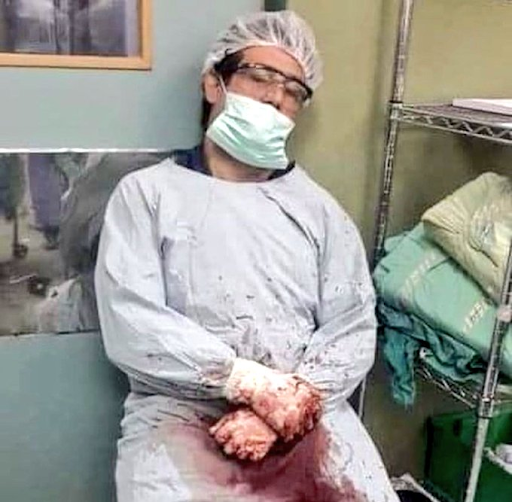
The photo of Adnan Al Bursh below went viral after he performed 28 surgeries in one day during the Great March of Return in 2018-2019, when Israeli snipers shot over 6106 Palestinians and killed over 250.


For about three months, Adnan El-Bursh was one of the health workers who provided live updates directly from the hospital despite being under siege by Israeli armed forces.. 
After patients, health workers, and forcibly displaced people were forced to leave Al-Shifa, he moved to the Indonesian Hospital, where he was injured in an attack. 
Dr. Adnan Al-Bursh's final interview with Al Jazeera recounted the harrowing events of Israeli occupation forces forcing doctors and patients to evacuate Al-Shifa Hospital. Despite the pressure, Dr. Al-Bursh persisted in serving the wounded and relocated to Al-Amal Hospital in Northern Gaza, from where he and several other health workers were abducted about five months ago.while caring for patients. He and most of the medical teams were moved to Israeli detention camps. Israel tortured Dr. Adnan to death in one of its interrogation centers.. 
An Israeli military spokesperson said that the prison service had declared Dr Bursh dead on April 19, saying that he had been detained for national security reasons in Ofer prison. The spokesperson did not comment on the cause of death.
The Israeli prison service issued a statement on April 19 saying that a prisoner detained for national security reasons had died in Ofer Prison in the West Bank, but giving no detail on the cause of death.  A prison service spokesperson confirmed that the statement referred to Dr Al-Bursh, and said the incident was being investigated.
The Palestinian Prisoners’ Affairs Commission and the Palestinian Prisoners’ Caucus said in a joint statement Thursday that Adnan Ahmad al-Bursh, a Palestinian surgeon and professor of orthopedic medicine, lost his life due to torture at the Israeli-run Ofer prison in the occupied West Bank last month. 
The statement said the 50-year-old Palestinian surgeon died in what it described as a “targeted killing” and “his body continues to be held” by the Israeli regime. Citing Palestinian authorities, both rights groups said Bursh was arrested along with a group of other doctors last December at al-Awda hospital near the Jabalia refugee camp in northern Gaza and that he died on April 19. 
The joint statement said another detainee, 33-year-old Ismail Abdul Bari Khader, also died in Israeli custody and his body was transferred on May 2 along with 64 other prisoners.
“Both victims died as a result of torture and crimes committed against prisoners in Gaza,” the statement said, adding that Bursh’s death “was part of a systematic attack on doctors and the healthcare system in Gaza.”Stressing that the surgeon’s death amounts to “murder”, 
Both rights groups reiterated their appeal to the United Nations and all international institutions to fulfill their obligations in connection with the crimes committed against Palestinian prisoners during the occupation. 
They stressed the need to “go beyond simply publishing reports, testimonies and warnings, because after almost seven months of genocide all this has lost its meaning and the occupation is supported by clear international forces.”  
Francesca Albanese, the United Nations special rapporteur on the human rights situation in the occupied West Bank and Gaza, said she was “very concerned” by the death of the prominent doctor.  “I call on the diplomatic community to take concrete action to protect the Palestinians. “No Palestinian is safe today under Israeli occupation,” she wrote in a statement to X on Thursday.  “How many more lives will have to be taken before UN member states, especially those that demonstrate genuine concern for human rights around the world, take action to protect Palestinians?”  
The whereabouts and conditions of many health workers who were taken from Al-Awda health centers, including hospital director Ahmed Muhanna, remain largely undisclosed by the IOF. However, released prisoners have shared testimonies of the torture and humiliation specifically endured by health workers in Israeli prisons
The Ministry of Health in Gaza has issued the following statement: 

"We condemn the murder of Adnan Al-Bursh, head of the Orthopaedic department at Al-Shifa Medical Complex, under torture inside the occupation prisons. The crime of killing human beings in the occupation prisons raised the death toll in the health sector since October 7 to 492.  We call on the international community and health and human rights organizations to intervene and visit the prisoners and protect them from torture."

The killing of another surgeon in Israeli custody is  heartbreaking,  Israel is killing the most skilled and the kindest people and  highlights the ongoing targeting of health workers amid the war on Gaza. Medical groups, including the World Health Organisation, have repeatedly called for a halt to attacks on Gaza healthcare workers. The Palestinian health ministry said in a statement that Dr Bursh’s death raised to 496 the number of medical sector workers who had been killed by Israel since Oct 7.  It added that 1,500 others had been wounded, while 309 had been arrested. 
According to the World Health Organization (WHO) attacks  on healthcare in the occupied Palestinian territory haven’t been limited to Gaza, with 421 attacks also reported in the occupied West Bank in the last six months. These include 302 obstructions to health access, and the use of force within health facilities.  
The WHO classifies an attack on health care as any instance of violence against or any obstructions that interfere with delivery or access to health services during emergencies, including psychological threats and intimidation of patients and workers. 
Israel accuses Hamas of using hospitals for military purposes and says its operations against them have been justified by the presence of fighters.  Hamas and medical staff deny the allegations.
The associations representing prisoners stated, “What happened to Al-Bursh was a deliberate assassination, part of Israel’s systematic targeting of doctors and the healthcare system in Gaza.”
Gaza’s health workers and patients face unprecedented mental health crisis Israel’s targeting of health workers has been denounced as an effort to undermine the Palestinian resistance on numerous occasions.
Testimonies from health workers released from prison describe severe beatings, deprivation of food and water, and forced humiliating treatment such as being chained and made to crawl.  Like other political prisoners taken by Israel since October 2023, health workers face severe long-term health consequences. 
The Resistance News Network reported that many continue to suffer from fractures and other injuries incurred early in their detention, with evident physical decline including significant weight loss and changed appearances. 
In addition to torture and other physical abuses, Palestinian prisoners face health risks exacerbated by poor living conditions in Israeli prisons. One of the most recent health crises was a scabies outbreak at Al-Naqab prison, caused by overcrowding, reduced water supply, and inadequate sanitary facilities.  
Six months of constant bombardment, siege and obstruction of aid deliveries have annihilated the health system in Gaza. Only 11 hospitals out of 36 are partially functioning and the Palestinian Central Bureau of Statistics (PCBS) reported that some 350,000 people suffering from chronic diseases in Gaza are unable to access vital medicines, supplies, and services. seeking to care for them face acute shortages of supplies including medicines, fuel, water and food.
Despite ongoing assaults and the targeting of their facilities, Gaza’s health workers continue to provide care to thousands of patients and displaced individuals.
Israel has  carried out an unrelenting offensive on the Palestinian enclave since a cross-border attack by Hamas last October 7, which killed some 1,200 people. Nearly 34,600 Palestinians have since been killed, mostly women and children, and 77,800 injured amid mass destruction and severe shortages of necessities  due  to. Israel’s indiscriminate bombardment.
More than six months into the Israeli war, vast swathes of Gaza lay in ruins, pushing 85 percent of the enclave’s population into internal displacement amid a crippling blockade of food, clean water and medicine, according to the UN.  Israel stands accused of genocide at the International Court of Justice.  An interim ruling in January ordered Tel Aviv to stop genocidal acts and take measures to guarantee that humanitarian assistance is provided to civilians in Gaza.
Urgent action is needed right now.We must mourn Dr Adnan Al-Bursh who was tortured to death in Israeli detention  and  demand justice . Attacks on healthcare must cease, Israel’s complete siege must be lifted, and an immediate ceasefire must be brokered to safeguard innocent lives.

Saturday, 27 April 2024

As South Africa marks 30 years since apartheid, time for Israeli apartheid to be dismantled too.

Today marks South Africa’s Freedom Day, 30 years since the end of  46  years of the brutal system of racial discrimination known as apartheid and the birth of its democracy.  Wishing it a happy Freedom Day. It took many years of brave resistance to bring this inhuman system to an end. The struggle against apartheid, South Africa's systematic regime of racial segregation and discrimination, was a long and arduous journey marked by the resilience of its people and the leadership of several key figures. 
The South  African  apartheid   regime  implemented  policies  of  racial  segregation  and discrimination against the majority black population, controlling them through various means, including legislation and law enforcement, rather than regular military strikes. The apartheid government used  its security  forces to  enforce segregation, suppress  dissent, and  maintain control, often leading to violence, such as the Sharpeville Massacre in 1960 and the Soweto Uprising  in  1976.  These actions  were part  of  a  broader system  of  institutionalized racial discrimination designed to maintain white minority rule over the black majority, 
The dismantling of apartheid began in earnest in the early 1990s, primarily under the stewardship of two influential leaders: the then South African President F.W. de Klerk and the indefatigable freedom fighter Nelson Mandela. De Klerk, recognizing the unsustainability of apartheid, initiated the repeal of racially discriminatory laws. Simultaneously, released from a 27-year prison term in 1990, Mandela emerged as a symbol of resistance and reconciliation.  
However  resistance to the end of apartheid was fierce. Hardliners within De Klerk's National Party and extremist groups such as the Conservative Party and the Afrikaner Weerstandsbeweging vehemently opposed the transition, fearing loss of power and perceived erosion of Afrikaner culture. Violence, unfortunately, was a by-product of these transitions, culminating in events like the Boipatong massacre in 1992. 
South Africa has made substantial strides since the end of apartheid. Political and social equality has improved, and South Africans enjoy a significantly higher degree of civil liberties. However, challenges persist, including economic inequality and lingering racial tension..
The journey of South Africa has been vividly captured in cinema. "Cry Freedom" (1987), featuring Denzel Washington, tells the story of anti-apartheid activist Steve Biko and journalist Donald Woods. "Invictus" (2009), with Morgan Freeman and Matt Damon, portrays Mandela's use of the Rugby World Cup as a unifying force. Both movies were critically acclaimed and well-received by the public, shedding light on the complexities of apartheid. 
The Independence of South Africa South Africa's independence from Britain was formalized in 1934, although the country remained a dominion until it was fully sovereign in 1961. However, apartheid, which began in 1948, stifled true independence until its dissolution in 1994.
Overcoming apartheid required widespread domestic resistance and international pressure, including economic sanctions. Mandela's African National Congress (ANC) and other groups played pivotal roles in peaceful protests and armed resistance. 
After the African National Congress (ANC) won South Africa’s first democratic elections in April 1994, world-wide jubilation commenced to celebrate Nelson Mandela’s victory.Since apartheid, South Africa has become a beacon of democratic hope in Africa, although it continues to grapple with economic disparities and other societal challenges. The official unemployment rate of 32% is the highest in the world, and the rate for young people between the ages of 15 and 24 is higher than 60%. More than 16 million South Africans – 25% of the country – rely on monthly welfare grants for survival. 
 South Africa is still the most unequal country in the world in terms of wealth distribution, according to the World Bank, with race a key factor.  While the damage of apartheid remains difficult to undo, the ANC is increasingly being blamed for South Africa’s current problems. 
In the week leading up to the anniversary, countless South Africans were asked what 30 years of freedom from apartheid meant to them. The dominant response was that while 1994 was a historic moment, it is now overshadowed by the joblessness, violent crime, corruption and near-collapse of basic services such as electricity and water that plagues South Africa in 2024.
Despite  all  this, the spirit of Ubuntu, a philosophy emphasizing common humanity, remains strong.  While we celebrate this historic milestone  today, Palestinians  meanwhile  continue to suffer under the brutal Israeli Apartheid, regime.
 Apartheid is a particularly severe form of institutional discrimination and systematic oppression based on race or ethnicity, and is prohibited by international law. While apartheid was coined in relation to South Africa, international treaties, including the International Convention on the Elimination of All Forms of Racial Discrimination, UN resolutions, and many countries’ domestic laws define it as a universal legal term that applies globally. 
Apartheid is also a crime against humanity, as set out both in the 1973 International Convention on the Suppression and Punishment of the Crime of Apartheid and the 1998 Rome Statute of the International Criminal Court. It consists of three primary elements:  An intent to maintain domination by one racial group over another; A context of systematic oppression by the dominant group over the marginalized group; Inhumane acts such as “forcible transfer” and “expropriation of landed property.” Under international law, race and racial discrimination have been interpreted to mean more than skin color or genetic traits. 
South  Africa's  unique  history  with  Apartheid  has  led  it  to  a  position  of  solidarity  with the Palestinians, recognizing  similar forms of  segregation  and  oppression.  This  perspective has even led South Africa to approach the International Court of Justice (ICJ) under the Genocide Convention regarding acts committed by Israel in its conflict in Gaza, highlighting a shared experience of systemic injustice and the importance of international solidarity. The comparison between the Israeli military actions in tthe Occupied Palestinian Territories and  the South  African  apartheid  regime's  treatment  of  black South  Africans  reveals  both similarities and differences,
There can be no room for double standards. Human rights must prevail, demanding justice, accountability, and the dismantling of apartheid in Palestine. like we  did  in  South Africa The world is watching. Denying millions of Palestinians their fundamental rights, solely because they are Palestinian, is a violation of international law, and that reality is becoming more and more clear to much of the international community.
Israel, despite its historical support for the previous South African apartheid regime, always denied the term "Israeli Apartheid", arguing that the situation is fundamentally different from Apartheid South Africa, primarily because the conflict is nationalistic and territorial rather than racial. They point to the Arab citizens of Israel, having the same legal rights as Jewish citizens, including the right  to  vote  and  be  elected  to  the  Israeli parliament, as evidence against the apartheid analogy. 
However  Israel's practices in Gaza, similar to  the  wider Occupied Palestinian Territories  (OPT) have drawn intense scrutiny and criticism, with numerous human rights organizations and experts drawing  parallels  to  apartheid  systems. These  practices  include  systemic  discrimination, segregation, and policies aimed at controlling and oppressing the Palestinian population. Amnesty International  in 2022 highlightted the deep discrimination embedded within Israel's policies towards Palestinians, including home demolitions, forced evictions, and a legal and political system  designed  to  privilege  Jewish  Israelis  at  the  expense  of  Palestinians.  The organization  points  to  Israel's  strategies  of  fragmentation,  dispossession,  segregation,  and economic deprivation as central to maintaining this system of oppression. 
Human  Rights Watch's  analysis underlines  that  the  crime  of Apartheid  involves  three primary elements: an intent to maintain domination by one racial group over another, systematic oppression by one racial group over another, and inhumane acts carried out pursuant to these policies.  It  notes  that  Israeli  policies  towards  Palestinians,  including  forcible  transfer, expropriation of land, and creation of separate reserves, fit within these criteria,The United Nations has also voiced concern, with a UN expert on human rights stating that Israel's 55-year occupation of Palestinian territories constitutes Apartheid.
We must continue to oppose attempts to thwart opposition to Israel’s apartheid regime. The international movement against South African apartheid faced similar attacks, but the end of apartheid in South Africa was made possible by the international community’s continued solidarity.
In Palestine, as in South Africa, it  is  only right  that we  stand  again alongside the oppressed. We know that, just as before, it will be the courage of those living under apartheid, alongside the efforts of countless activists around the world compelled to act by the force of injustice, that will end apartheid. Palestinians have never   stopped demanding their freedom. We must support them: by building a movement of solidarity with the Palestinian people and compelling those in power to act.  
The people of the world stand with the students fighting for an end to the funding of Israeli genocide and apartheid at their universities and join them in their firm commitment to a liberated Palestine! 
Anyone that has studied the history of South Africa and remembers the anti apartheid movement that rocked college campuses in the 80s knows that this is the beginning of the end for Israel. like it was for apartheid South Africa
Support  the resistance and be on the right side of history. Remember how  South Africa's  Apartheid regime was defeated. Change is possible..Saluting all who fought to end apartheid in South Africa  It's time to act. Israel’s racist system of apartheid  and the genocide against  the Palestinians  must end now too! Let our  solidarity with the Palestinian people be unbreakable! Free, Free Palestine,

Wednesday, 17 April 2024

Beware the Black Dog


The black dog started barking, but I took it out to the garden and tried to let him loose. He's a funny ancient creature who always finds his way somehow into peoples hearts and souls, currently feeding on war crimes, grief and sadness across the world.
Can be found on mexican borders, calais, gaza, the ghosts of hillsborough and Grenfell, does not discriminate between the rich and poor, releases a sense of helplessness that is impossible to ignore. Anywhere that he senses pain, feeding and masticating whether under sunshine or rain. Feeding on our universal sadness his teeth sinking deeply in, devouring any joy within.
It's so easy to surrender, allow our souls to be gnawed, despite trying so hard to keep the savage hound at bay, has killed my brothers and sisters, suffocated so many beating hearts, Some of us to ease the pain will try to drink ourselves to death, give up our defences and offer no resistance, allow us to be taken by his darkness on days when we are unable to fight back.
In unison we can resist him, spreading love and peace, as we walk among trees, following soothing breeze, following our dreams, releasing friendship flowers that always blossom, the companianship of kindness, sharing thoughts, another’s care, catching sunbeams and rainbows of possibility.
Because he fears all these things and all the solidarity and love that we share, as we expose the injustices of the world with deep empathy, knowing kindness is something that he runs from, something this demon finds difficult to overcome.
But be very careful, beware of the Black Dog, because he will always be there, hiding and lurking somewhere. Very cunning, always outwitting, draining energy, altering mindscapes,frightening and debilitating, creating abyss.
Collectively we don't have to feed this hungry beast of burden, even if he's calling out your name, let our love and daily battle collectively overcome the pain he delivers. To destroy the black dog, refuse his hungry bite, in name of survival with all energy that you can muster. slay his affliction, cast this energiser of sadness far into the wilderness, out of sight, while following paths of light.
But remember to be ever be cautious, because he's never far away. I thought i'd destroyed the fiend once and on a warm summer morning danced with joy, but heard his fearsome howl once again. It's an endless fight, of endureness, perhaps one day we will win and bury him forever. Maybe then this sense of hopelessness and despair will dissapear.

Saturday, 13 April 2024

Identity

   
                                             Image : Georges Seurat. 1884

I show some  people respect  
And I will always help  those who need me,
It’s not because I’m old fashioned
It’s because I was raised property,  
Because of this will always disdain the fucking Torys 
With loud profanity as long as I'm still alive,
While volcano rumblings of cosmic grief 
Keep releasing eternal rhythms of eternal love,
Under the gaze of stars and moonshine
Blossoms of springtime, heralding new beginnings,
My quest for peace unrelenting
My determination unfaltered,
I will never lose purpose
Continue striving for the light,
In a world lost in the fog 
My wild palms will cup the cracked dawn,
Without fear and retribution
Finding ripples to calm  my senses.

Thursday, 28 March 2024

On the bridge between brutality and humanity


I'm glad that I have strong beliefs
Am able to say what I  feel,
Keep  calling for a ceasefire
An end to oppression and war,
Use my voice to question
Take a stand against barbarity,
When Fascism and cruelty 
Has become the norm for so many.

I believe in extreme kindness
Forces of good against evil,
The power of love and empathy
Among the painful tug of times undertow,
Remembering all those that struggle to be free
People who keep resisting malevolent violence,
Who  do not accept a colonising rogue country
Trying to exterminate another nation of people.

With militant identity and unfaltering breath
I support lion hearts, their liberty denied,  
Voices that continue to dream for a better world
Defying forces of injustice and suppression,
The protestors demonised and silenced
People enslaved all over the world,
On the pavements and roadsides
Far away from where I abide.

With famine and starvation in Gaza imminent
Thousands of displaced forced to eat animal feed,
As bombs continue to  rain down  on  innocents
I hope for an end to this ongoing suffering,
Ignore the politicians that cruelly diminish
Keep following rebel souls that break the chains,
Shining their truth for those unable to see
Seeking a new reality beyond current insanity,